The AI Visibility Blind Spot Your SEO Dashboard Will Not Show
Your SEO dashboard may look stable while AI engines recommend competitors. Learn why AI visibility needs its own measurement layer and what agencies should test first.
Most marketing teams already know how to read an SEO dashboard. They can see keyword movements, organic traffic, impressions, backlinks, technical errors and conversion pages.
That is useful. It is not enough anymore.
A growing part of the buyer journey now happens before a prospect clicks a search result. People ask ChatGPT, Claude, Gemini, Perplexity and other answer engines for a shortlist, a recommendation, a comparison or a plain-English explanation. In those moments, your brand can be visible, invisible, misdescribed or displaced by a competitor.
A normal SEO dashboard will not always warn you when that happens.
The blind spot in traditional SEO reporting
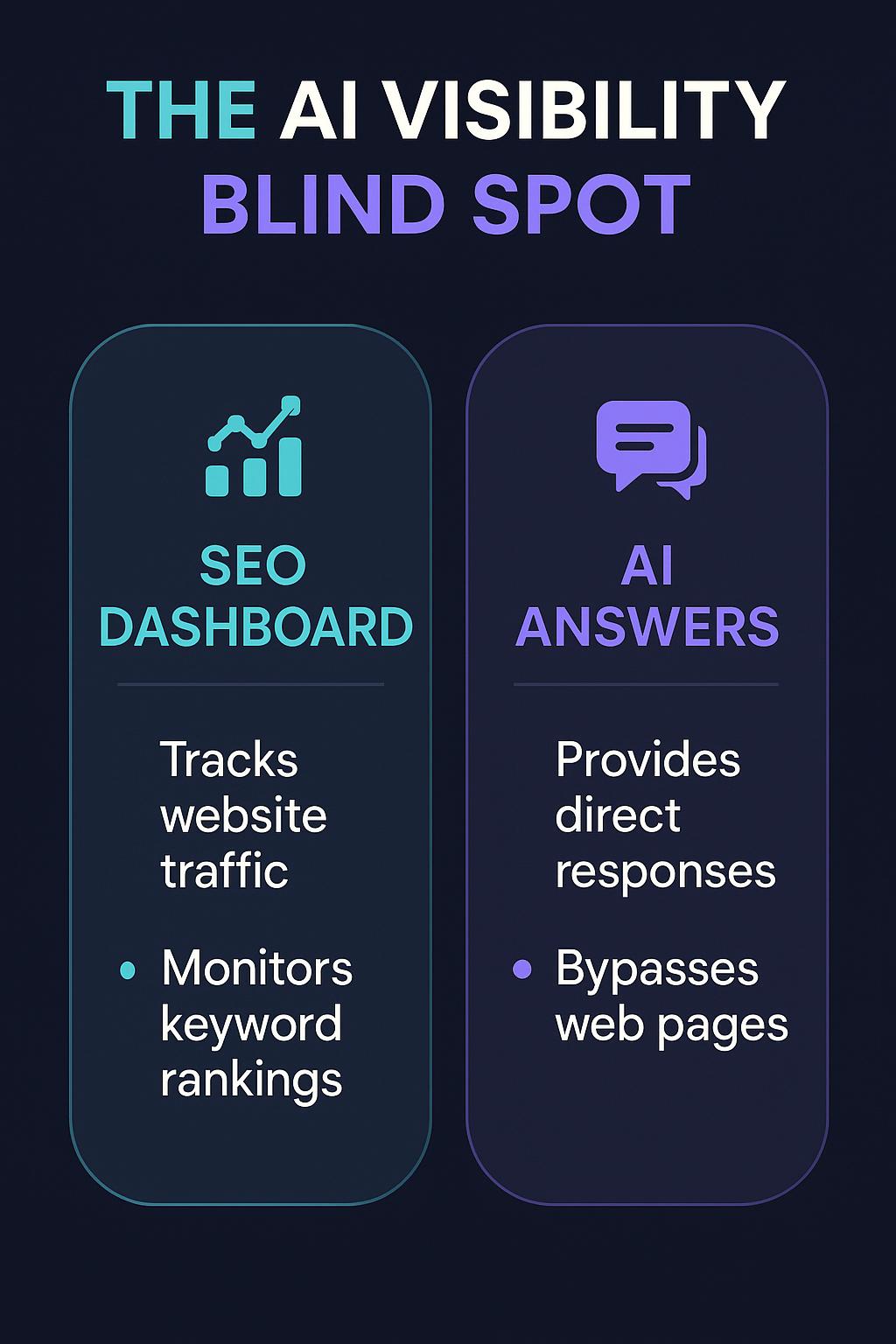
Traditional SEO reporting is built around search result pages. It measures whether pages rank, whether people click, and whether the website performs technically.
AI answer visibility is different. A buyer might ask:
- Which fibre network planning tools are used in South Africa?
- Which companies help agencies measure AI visibility?
- What are the best platforms for generative engine optimization?
- Which local provider should I compare before choosing a vendor?
The answer may mention three competitors, cite old information, ignore your strongest proof, or summarise your brand in a way that does not match your positioning.
Your website traffic report may still look stable while the recommendation layer above it is shifting.
That is why AI visibility has to be measured separately from normal SEO.
AI engines do not behave like one search ranking
It is tempting to ask one question in one AI tool and treat the answer as the truth. That is not credible.
AI answers vary by engine, wording, geography, timing, context and available sources. A brand can appear in Perplexity but not in Gemini. A competitor can be recommended in one answer and absent in another. A citation can point to a directory, a LinkedIn page, a blog post, a review site or a page on your own website.
That means the work is not about chasing a magic ranking. It is about tracking patterns.
ApexGEO looks for directional signals:
- whether your brand is mentioned
- how often competitors are mentioned
- which sources AI engines use
- whether descriptions are accurate
- what fixes can improve the brand evidence layer
This is the practical side of generative engine optimization and answer engine optimization.
What agencies should show clients
Agencies do not need to replace SEO reports. They need to add a new visibility layer.
A useful AI visibility snapshot should show:
- The prompts tested
- The engines checked
- The date and region context
- Whether the brand appeared
- Which competitors appeared
- Which sources were cited or implied
- What content, schema, profile or authority gaps should be fixed first
That is a much better client conversation than saying, "AI is coming." It turns the trend into evidence, risk and action.
It also creates a clear commercial opportunity. Agencies can use AI visibility audits to open new client conversations, defend retainers, and identify content or technical work that traditional SEO dashboards do not surface.
The first fix is usually not a social post
Social helps, but the first fix is normally the evidence layer.
AI engines need consistent public information about who the brand is, what it does, who it serves and why it should be trusted. That can include:
- clear website pages
- structured data
- useful blog content
- complete LinkedIn and business profiles
- credible third-party references
- consistent naming and descriptions across platforms
- case studies, FAQs and comparison content
A social post can distribute that evidence. The owned website should hold it.
That is why ApexGEO treats the blog as the canonical source, and uses LinkedIn, X, Facebook and Instagram as distribution and corroboration channels.
A simple test for your brand
Ask three AI engines a realistic buyer question today. Do not ask for your brand by name. Ask the way a prospect would ask before they know who to trust.
Then record:
- Did your brand appear?
- Did a competitor appear?
- Was your positioning accurate?
- Which sources shaped the answer?
- What would you fix first?
If the answer is unclear, you have found the gap.
ApexGEO can run that process in a repeatable way and turn it into an action list. Start with a free South Africa AI Visibility Snapshot for one brand or client.
Q: Does this mean SEO is dead?
A: No. SEO still matters because AI engines often learn from, cite and summarise web content. The change is that rankings and traffic are no longer the full picture. Brands also need to know how they appear inside AI-generated answers.
Q: Can any platform promise that my brand will be recommended by AI tools?
A: No credible platform should promise that. AI answers are probabilistic and change over time. The responsible approach is to measure patterns, improve the evidence layer, and track whether visibility improves directionally.
Q: What should an agency do first?
A: Start with one client or prospect and run a focused AI visibility snapshot. Use realistic buyer prompts, compare competitors, record the sources, and turn the findings into a practical content, schema and profile-fix plan.