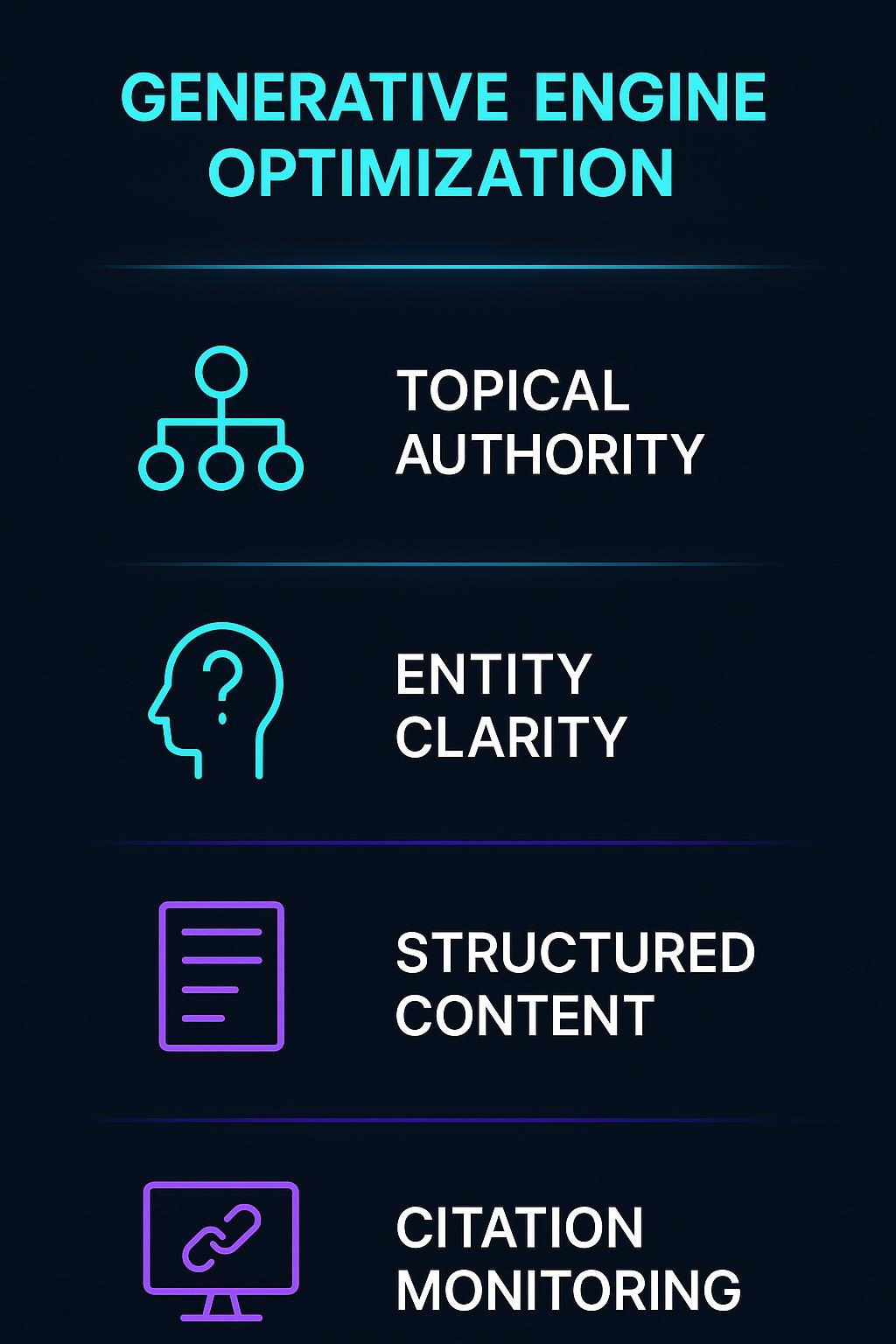
What Is Generative Engine Optimization? A Practical Guide for Brands and Agencies
A practical guide to Generative Engine Optimization: what GEO means, why AI answer visibility matters, how it differs from SEO and AEO, and how brands can start measuring it.
Generative Engine Optimization, often shortened to GEO, is the practice of improving how a brand is understood, cited and recommended by AI answer engines.
Those answer engines include ChatGPT, Gemini, Perplexity, Claude, Google AI Overviews and other systems that generate direct answers instead of simply showing a list of links.
For years, most marketing teams measured search visibility through rankings, impressions, clicks, backlinks, technical health and organic traffic. Those metrics still matter. SEO is not dead.
But the buyer journey has changed.
A prospect can now ask an AI system:
- Which platform should I use for AI visibility monitoring?
- Which agencies understand generative engine optimization?
- What are the best tools for measuring Share of Answer?
- Which companies help brands understand how ChatGPT describes them?
The answer may mention your brand, ignore your brand, recommend a competitor, cite an old source, or describe your offer inaccurately.
A normal SEO dashboard will not always show that.
That is why GEO exists.
A simple definition of GEO
Generative Engine Optimization is the process of making a brand easier for AI answer engines to understand, verify, cite and recommend.
In practical terms, GEO asks:
- Does the brand appear in AI-generated answers?
- Is the brand described accurately?
- Which competitors appear for the same prompts?
- Which sources shape the answer?
- Which public evidence should be improved?
- Does visibility improve over time?
GEO is not about tricking AI systems. It is not a guaranteed ranking formula. It is not a replacement for SEO.
The responsible approach is to measure patterns, improve the evidence layer and track whether the brand becomes more visible and accurately represented in AI answers.
Why GEO matters now
Search used to be mostly link-led. A buyer searched, scanned results, clicked a page and compared options.
That still happens, but it is no longer the whole journey.
A growing number of discovery moments now happen inside answer engines. Buyers ask for summaries, recommendations, comparisons, definitions and shortlists. The AI system may compress the market into a few names and a few cited sources.
That creates a new layer of visibility above the click.
A brand can have good SEO performance and still be weak in AI answers. A competitor can be mentioned repeatedly because its public evidence is clearer, more consistent or more frequently cited. A brand can also be misdescribed because old profiles, thin pages or inconsistent messaging are shaping the answer.
GEO matters because it gives marketing teams a way to measure and improve that layer.
GEO vs SEO vs AEO
GEO overlaps with SEO and Answer Engine Optimization, but it is not identical.
SEO focuses on visibility in search results. It measures rankings, clicks, impressions, technical health, backlinks and organic conversions.
Answer Engine Optimization focuses on answer readiness. It asks whether content is structured clearly enough to answer specific questions, often through concise explanations, FAQs, schema and direct response formats.
GEO focuses on AI visibility inside generated answers. It asks whether AI systems mention, cite, summarise or recommend the brand when responding to realistic buyer prompts.
The three disciplines work together.
Strong SEO gives AI systems better content to discover. Good AEO makes answers easier to extract. GEO measures whether that evidence is actually showing up inside AI-generated responses.
What AI answer engines use as evidence
No responsible GEO provider should claim to know every private ranking mechanism inside ChatGPT, Gemini, Perplexity or Google AI Overviews.
But practical observation shows that public evidence matters.
Useful evidence can include:
- clear website pages
- consistent brand descriptions
- useful blog articles and guides
- glossary pages
- FAQs
- comparison pages
- schema markup
- complete LinkedIn and business profiles
- third-party articles and mentions
- reviews and directories where relevant
- case studies
- research reports
- citations from credible sources
The goal is to make the brand easier to understand and verify.
If your website says one thing, your LinkedIn profile says another, your old directory listings use outdated positioning and no one else cites your work, AI systems have a weaker evidence layer to draw from.
What a basic GEO audit includes
A practical GEO audit does not start with hype. It starts with measurement.
A useful first audit should include:
- A list of realistic buyer prompts.
- The AI engines tested.
- The date and geography of the test.
- Whether the brand appeared.
- Which competitors appeared.
- How the brand was described.
- Which sources were cited or clearly influential.
- What evidence gaps should be fixed first.
- A repeatable benchmark for future comparison.
For agencies, this creates a stronger client conversation than saying, "AI search is coming."
It turns AI search into evidence, risk and action.
How agencies can start with one client
Agencies do not need to rebuild their entire service model overnight.
Start with one client or one prospect category.
Choose 10 realistic buyer prompts. Include category prompts, comparison prompts, problem prompts and local or industry-specific prompts.
Test the prompts across ChatGPT, Gemini and Perplexity. Record the answers. Note brand mentions, competitor mentions, citations and description accuracy.
Then build a simple action list:
- pages to clarify
- FAQs to add
- profiles to update
- schema to improve
- comparison content to create
- third-party references to pursue
- case studies to publish
That becomes the first GEO roadmap.
What should be measured over time
GEO should not be measured from one prompt on one day.
AI answers vary by engine, wording, context, geography and time.
A better measurement model tracks patterns across a prompt library.
Useful metrics include:
- AI citations
- Share of Answer
- brand mentions
- competitor mentions
- description accuracy
- source diversity
- branded search lift
- organic traffic to GEO content
- demo or snapshot requests
- backlinks and media mentions
The primary goal is not a vanity score. The goal is to understand whether the brand is becoming easier for AI systems and buyers to trust.
What to fix first
The first GEO fix is usually the evidence layer.
Before chasing complicated tactics, make sure the basics are strong:
- The homepage explains what the brand does.
- Service pages answer real buyer questions.
- Key terms are defined clearly.
- Public profiles are consistent.
- FAQs address buyer objections.
- Case studies and proof exist.
- Important pages are internally linked.
- Content is structured in a way that can be summarised.
Social distribution helps, but the owned website should hold the canonical evidence.
How ApexGEO fits into this workflow
ApexGEO is built for teams that need this measurement to be repeatable rather than anecdotal. Instead of saving one-off screenshots from different AI tools, a GEO workflow should preserve the prompt, engine, date, answer, citations, competitor mentions and recommended fixes in one place.
That gives agencies a cleaner client report and gives in-house teams a practical roadmap: first measure the answer layer, then improve the public evidence, then retest against the same prompt set.
Final thought
The search market is not moving from SEO to GEO. It is moving from a link-only view of visibility to a broader answer-layer view of visibility.
Brands still need rankings, clicks and technical SEO.
They also need to know what AI systems say when buyers ask for recommendations.
That is the practical role of ApexGEO: measure AI visibility, identify the evidence gaps and help brands improve how they appear across the new answer layer.
Start with a free AI Visibility Snapshot and see what the answer engines currently say about your brand or category.
Q: Is GEO the same as SEO?
A: No. SEO focuses on search results, rankings and clicks. GEO focuses on how AI answer engines describe, cite and recommend your brand inside generated answers. They overlap, but they are not the same.
Q: Does GEO replace SEO?
A: No. SEO still matters because AI systems often use web content as part of the evidence layer. GEO adds a new measurement and optimisation layer above traditional search visibility.
Q: Can any platform guarantee that ChatGPT will recommend my brand?
A: No credible platform should guarantee that. AI answers are probabilistic and change over time. The responsible approach is to measure patterns, improve evidence and track directional improvement.
Q: What is the first step in GEO?
A: Start with an AI visibility snapshot. Test realistic buyer prompts across multiple AI engines, record whether your brand and competitors appear, check the cited sources and identify the first evidence gaps.
Q: Who needs GEO?
A: SEO agencies, digital marketing agencies, enterprise marketing teams, SaaS companies, consultants and founders who rely on being discovered, compared or trusted online should understand GEO.