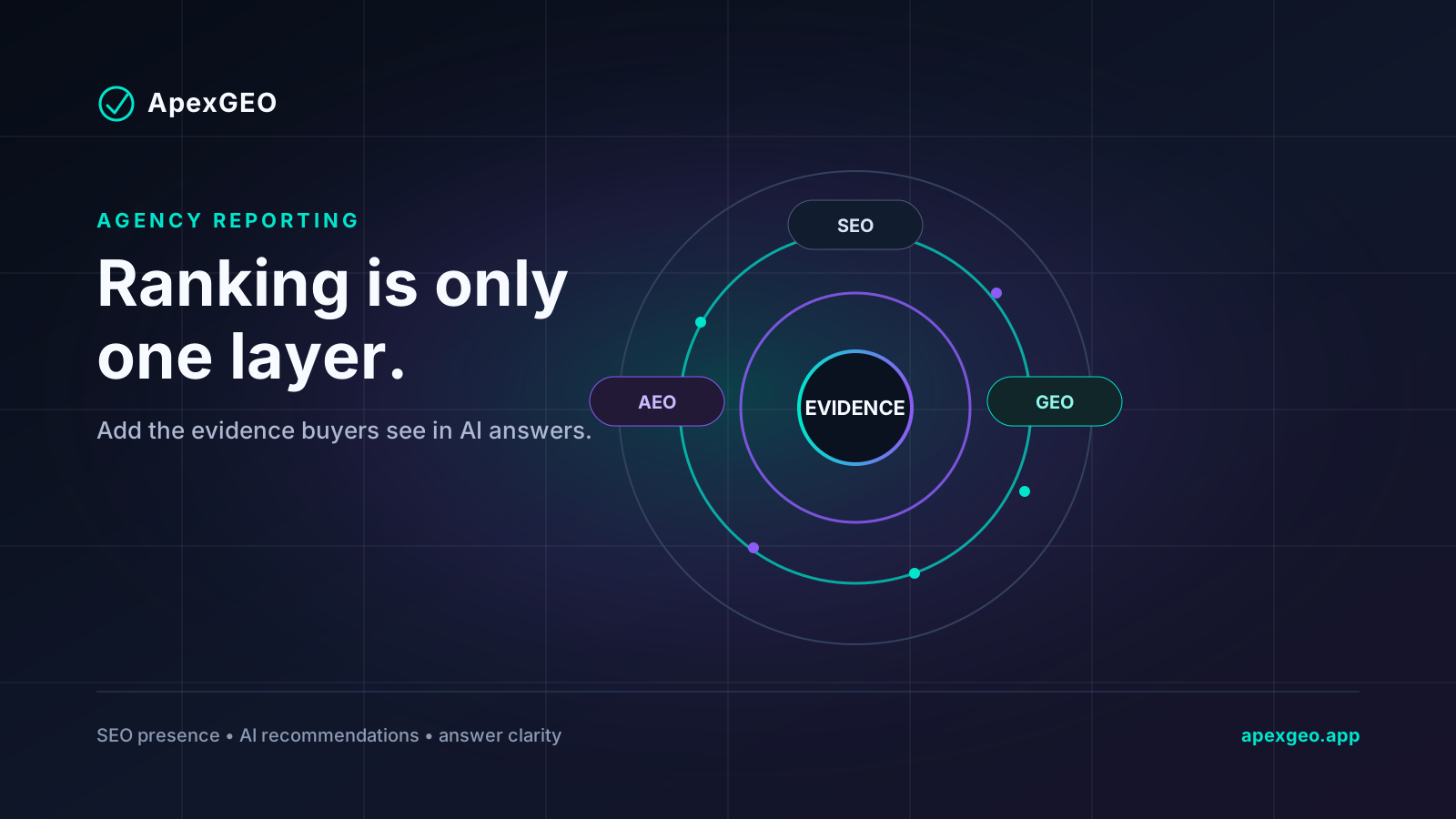
Ranking Is Only One Layer: How Agencies Add GEO and AEO to Client Reporting
A ranking report cannot show what buyers see in AI-generated recommendations. Here is how agencies can add a practical GEO and AEO layer to client reporting.
A client can rank well in search and still be absent from the shortlist an AI assistant creates.
That is the gap agencies now need to explain.
SEO reports remain useful. They show search visibility, technical performance, organic demand, and the pages earning attention. But buyers increasingly ask ChatGPT, Claude, Gemini, Perplexity, and other answer engines to compare providers, recommend tools, explain risks, and build shortlists.
Those interactions do not always produce a conventional search result or click. They produce an answer. A ranking dashboard cannot show whether that answer names the client, recommends a competitor, repeats outdated positioning, or relies on a source the client does not control.
Ranking is therefore one layer of visibility, not the whole picture.
The client reporting gap
Most monthly SEO reports answer familiar questions:
- Which pages gained or lost rankings?
- How many impressions and clicks did the site earn?
- Which technical issues need attention?
- Which content generated traffic or conversions?
- How does the client compare with competitors in search?
Those questions still matter. The gap appears when the client asks a different question:
What do AI tools tell buyers about us?
A traditional ranking report is not designed to answer that. It may show that the client ranks for an important keyword while an AI answer recommends three competitors and omits the client entirely. It may show stable traffic while an answer engine describes the company using old services, the wrong market, or an incomplete value proposition.
This does not mean SEO has failed. It means discovery now has an additional layer.
ApexGEO’s existing guide to GEO, SEO, and AEO explains how the disciplines relate. The reporting question is more operational: what should an agency add to the client pack on Monday morning?
Three layers, three different questions
The clearest client conversation separates the layers without pretending they are unrelated.
SEO: Can buyers find the client in search?
SEO measures presence in search engines and the health of the website that supports that presence. Agencies track rankings, impressions, clicks, links, crawlability, structured data, conversions, and content performance.
These signals remain foundational. Clear pages, credible references, technical health, and topical authority also make a brand easier for AI systems to understand.
GEO: Does the client appear in generated recommendations?
Generative Engine Optimization focuses on how a brand appears inside AI-generated answers. The useful signals are not a universal position number. They include:
- whether the brand is mentioned;
- which competitors are mentioned;
- whether the brand is recommended, compared, or omitted;
- how the answer frames the brand;
- which sources are cited or appear to shape the answer;
- whether the description is accurate.
These outputs vary by engine, prompt wording, timing, geography, and available evidence. That makes GEO measurement directional and repeatable, not absolute.
AEO: Is the client’s information easy to extract as an answer?
Answer Engine Optimization focuses on whether content is structured clearly enough to support a direct, accurate response. Useful work includes concise definitions, question-and-answer sections, factual headings, relevant schema, consistent entity details, and pages that answer buyer questions without forcing a system to infer the basics.
AEO does not guarantee that an answer engine will select a page. It improves the clarity and usefulness of the evidence available.
What an AI visibility snapshot should contain
The practical addition to a client report is a focused AI visibility snapshot. It should be small enough to understand and rigorous enough to repeat.
1. The buyer prompts tested
Start with realistic questions a prospect would ask before knowing which provider to choose. Avoid prompts that name the client, because those only test whether an engine can repeat information about a known entity.
Examples include:
- Which platforms help agencies monitor AI search visibility?
- What should a growing company compare before choosing a fibre network partner?
- Which providers are suitable for a South African SME needing working capital?
- What are the safest alternatives to our current software category?
The prompt library should cover discovery, comparison, risk, trust, and shortlist intent.
2. The engines and context
Record the engine, date, region, and relevant session context. AI outputs change. A useful report makes clear what was tested rather than presenting one answer as a permanent fact.
3. Brand and competitor presence
For each prompt, record whether the client appeared and which competitors appeared. The important question is not only mention frequency. It is how each brand was framed.
A competitor may be repeatedly recommended because its pricing is clearer, its category language is more consistent, or its proof is easier to retrieve. That explanation is more actionable than a red or green mention count.
4. Citations and source patterns
Where citations are available, capture the exact sources. Where they are not, note the public pages and source categories that appear consistent with the answer.
Useful categories include:
- owned service and product pages;
- blog and resource content;
- documentation and FAQs;
- case studies and customer proof;
- directories and marketplace listings;
- review sites;
- LinkedIn and company profiles;
- news and independent references.
The goal is to understand which public evidence the answer trusts.
5. Accuracy gaps
An omission is not the only risk. A brand can appear and still be misrepresented.
Track incorrect geography, outdated services, weak positioning, confusing category labels, missing product lines, and claims that do not match the client’s current offer. Prioritise errors that can materially affect a buying decision.
6. The next fixes
Every finding should lead to a practical action. Examples include:
- rewrite an unclear service page;
- add a factual comparison page;
- publish a useful buyer guide;
- add or correct organisation and service schema;
- improve case-study evidence;
- align company descriptions across public profiles;
- add concise FAQ answers to important pages;
- earn credible third-party references.
A snapshot without a fix list is observation, not a service.
Do not turn AI visibility into another vanity dashboard
The easiest mistake is to replace one oversimplified number with another.
A single “AI rank” can look reassuring, but there is no universal AI results page. Answers differ by platform and context. A score can be useful as a directional summary when its inputs are visible, but it should not hide the underlying prompts, mentions, citations, and accuracy checks.
Agencies should also avoid using one screenshot as proof of broad market visibility. Screenshots are evidence of a specific answer at a specific time. They are not a trend.
A credible report shows the method:
- Keep a stable core prompt set.
- Test across the selected engines.
- Record the date and context.
- Compare brand and competitor framing.
- Inspect citations and accuracy.
- Log the fixes shipped.
- Retest the same prompts.
- Report what changed and what did not.
That method is less dramatic than promising to “rank first in ChatGPT.” It is also more useful and defensible.
How agencies can package the service
The AI visibility layer can fit into an existing agency offer without replacing the SEO retainer.
The entry product
Use a one-brand AI visibility snapshot as a diagnostic. It gives the client a baseline, identifies the most important gaps, and shows whether a larger monitoring programme is justified.
The monthly layer
Add a compact section to the monthly client report:
- prompts tested;
- engines checked;
- brand and competitor presence;
- source and citation changes;
- accuracy issues;
- fixes completed;
- next priorities.
Keep the reporting honest when nothing changed. Stability is a valid finding. So is uncertainty.
The implementation work
The snapshot should create real work across content, technical SEO, digital PR, profile hygiene, entity clarity, and conversion messaging. The agency can prioritise that work by impact, confidence, and effort.
This is where the commercial value sits. The report opens the conversation, but the evidence fixes improve the brand’s public information layer.
Agencies that want a broader explanation of this opportunity can also read how to sell AI visibility audits without building the tooling.
A simple Monday reporting template
A useful client section can fit on one page:
Visibility question: What did buyers ask?
Coverage: Which AI engines were tested, when, and in which market context?
Presence: Was the client mentioned, compared, recommended, or omitted?
Competition: Which competitors appeared and why did the answers trust them?
Sources: Which owned or third-party pages shaped the answer?
Accuracy: Was the client described correctly?
Action: What should be fixed before the next test?
Retest date: When will the same prompt set be checked again?
This is enough to move the conversation beyond hype while keeping the evidence visible.
The bottom line
SEO remains essential. It is simply no longer the only layer agencies need to report.
Search rankings show where a client appears in conventional discovery. GEO shows whether the brand appears in AI-generated recommendations and comparisons. AEO improves whether the client’s public information can support a clear, accurate answer.
The strongest agency approach combines all three. Keep the SEO report. Add an AI visibility snapshot. Show the evidence. Ship the fixes. Retest.
Start with a free AI Visibility Snapshot to see what the traditional ranking report does not show.