Google Business Profile and AI Search: How Local Visibility Works Now
A Google Business Profile is owner-verified structured data about your business, which makes it unusually useful to answer engines. Here is what sits inside it, the weekly cadence that keeps it healthy, and why reviews are the signal most businesses under-invest in.
Why Answer Engines Care About Your Google Business Profile
Most discussions of AI visibility focus on national or global brands: whether ChatGPT names your SaaS product, whether Perplexity cites your documentation. Local businesses have a different problem with the same shape.
When a buyer asks an AI assistant "who can install a geyser in Durban North" or "best accountant for a small business in Sandton", they are asking a local-intent question. The answer they get is a short, synthesised recommendation — not ten blue links they will scroll through. Being one of the two or three businesses named in that answer is a materially different outcome from being the eleventh result on a page nobody reaches.
The reason your Google Business Profile matters to this is structural rather than magical. A profile is one of the very few places on the internet where a verified owner has published machine-readable facts about a business: its category, its service area, its hours, its location, its contact details, and an accumulating body of customer reviews. Structured, owner-verified, and continuously updated is exactly the shape of data that retrieval systems prefer.
It is worth being precise about the mechanism, because this space attracts a lot of overclaiming. Different assistants reach local information differently — some are tied directly into Google's own local data, others retrieve from the open web and from whichever search index sits behind them, and others rely mostly on patterns learned in training. What is consistent across them is that a business with a complete, consistent, well-reviewed public footprint is easier to surface confidently than one with a thin or contradictory one. No one guarantees placement in an AI answer, and anyone who tells you otherwise is selling something. The honest framing is that you are improving the odds and the quality of the signal, not buying a position.
What Actually Sits Inside a Google Business Profile
Before managing it well, it helps to see the profile as a set of distinct fields rather than one blob. Each one does a different job.
Business name. Should match your real-world trading name. Stuffing keywords into it ("Joe's Plumbing Cape Town Emergency 24/7") violates Google's guidelines and risks suspension. It also muddies the entity signal you are trying to sharpen.
Primary and secondary categories. The primary category is the single highest-leverage field in the whole profile. It is the main thing that determines which queries you are considered eligible for. Most businesses pick something vague on day one and never revisit it.
Service area or physical address. A storefront and a mobile service business are modelled differently. Getting this wrong either hides you from nearby searchers or spreads you so thin that you compete everywhere and rank nowhere.
Hours, including special hours. Stale public holiday hours are one of the most common and most damaging errors, because they generate a bad real-world experience that often converts directly into a one-star review.
Services and products. Explicit, itemised service listings give both search and retrieval systems concrete vocabulary to match against. "Plumbing" is weaker than a list that names geyser replacement, burst pipe repair, and leak detection.
Description, photos, and posts. Lower-leverage individually, but they contribute freshness and substance. Photos in particular correlate with engagement.
Reviews and review responses. The part that never stops moving, and the part this article keeps returning to.
Q&A. A public, crowd-editable question surface on your own listing. Left unattended, anyone can answer questions about your business. It is worth seeding this with the real questions you get and answering them properly.
The Operating Cadence: How to Actually Manage It
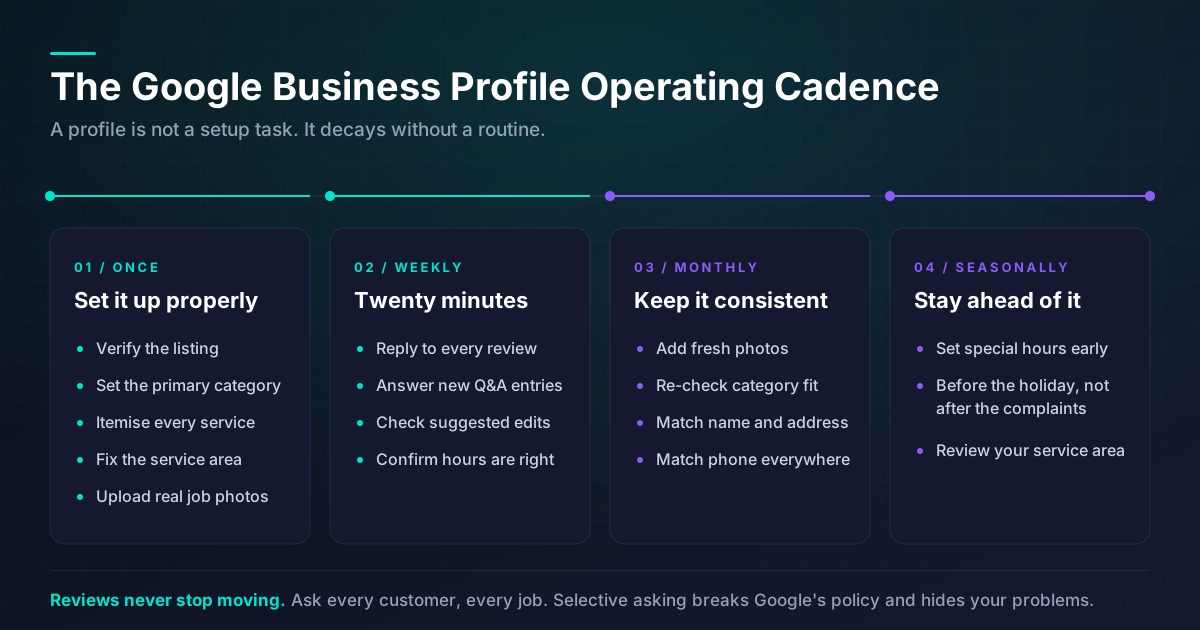
The single biggest mistake is treating a profile as a setup task. It is closer to a small, recurring operational routine. A workable cadence looks like this.
Once, properly: verify the listing, set the correct primary category, itemise services, fix the service area, upload real photos of real work, and write a description that reads like a human wrote it for customers rather than for a crawler.
Weekly: respond to every new review, answer any new Q&A entries, and check that nothing has been changed by "suggested edits" from the public. Profiles can be edited by third parties, and unnoticed changes to hours or category are common.
Monthly: add fresh photos, review whether your category still matches what you actually sell, and check that your name, address, and phone number still match your website and your other listings.
Seasonally: update special hours before public holidays, not after the complaints arrive.
The consistency point deserves its own emphasis. If your phone number on your website differs from your profile, and a directory has your old address, you have created ambiguity about which entity is which. Both traditional local search and AI retrieval resolve entities by corroboration across sources. Contradiction is the enemy of corroboration. This is the same principle behind brand facts at the national level, applied to a street address.
Reviews: The Signal Most Businesses Under-Invest In
Almost every small service business we have looked at has the same profile shape: the fields are roughly fine, and the review count is far too low.
This matters for three separate reasons.
Volume and recency function as social proof to humans. A business with nine reviews, the most recent from two years ago, reads as either struggling or closed. A business with two hundred reviews and three from last week reads as busy.
Reviews are text about your business written by other people. That is the single richest source of third-party language describing what you do, where you do it, and how well. It is the local equivalent of the citation density that drives generative engine optimization for larger brands.
Review flow is a leading indicator of service problems. If you only hear about a bad job when it appears publicly at one star, you have lost the chance to fix it privately.
The mechanics of getting reviews are where most businesses fail, and the failure is almost always the same: asking is left to memory. Someone means to ask, the job ends, everyone moves on, and nobody asks. Volume then depends entirely on whether a customer was annoyed enough to act unprompted — which biases your public record toward complaints.
One important compliance note. It is against Google's policies to solicit reviews selectively from customers you expect to be happy while suppressing the rest. This practice, usually called review gating, is both a policy violation and a strategic mistake: a perfect five-star record with no texture reads as manufactured, and it deprives you of the early-warning signal that negative feedback provides. Ask everyone, consistently, and handle the bad ones well in public.
What This Looks Like in South Africa
The South African context sharpens all of this. WhatsApp is the default communication channel for most trades and service businesses, and it has vastly higher open and response rates than email. An SMS or email review request often goes unread; a WhatsApp message sent within an hour of the job finishing usually does not.
There is also a competitive dimension worth naming honestly. In most local South African service categories, review counts are low across the board. That cuts both ways: it means the bar to becoming the most-reviewed business in your suburb is often lower than owners assume, and it means the advantage is available now rather than after everyone has caught up.
Regional entity signals matter too. Locally-framed queries carry suburb names, local terminology, and service vocabulary that differs from UK or US usage. A business whose profile and website use the language its actual customers use is easier to match to those queries. This is the local-search version of the regional calibration argument behind GEO tools built for South Africa.
Doing It Yourself Versus Running It as a System
Everything above is genuinely doable in-house. The profile fields are a few hours of focused work. The weekly cadence is maybe twenty minutes.
The part that reliably breaks is the asking. It depends on a person remembering, at the end of a job, to send a message — every time, for years. That is not a knowledge problem, it is a process problem, and process problems are best solved by removing the human memory step.
This is the specific gap ApexSignal was built to close. It is a Google review management service for South African service businesses, run by Brightsphere Technologies — the same team that builds ApexGEO. The model is deliberately narrow: when a job is marked done, the customer automatically receives a WhatsApp message with a two-tap path to your Google review page. Every customer is asked, not a filtered subset, which keeps it on the right side of Google's policy and gives you early sight of problems before they become public. It runs at R2 500 per month.
Two useful starting points if you want to see where you currently stand before committing to anything: the ApexSignal review audit shows your current profile and review position, and the review impact calculator models what a change in review volume would mean for your business.
For the broader question of whether AI assistants mention your brand at all — beyond the local map layer — the free AI visibility snapshot runs your brand against a structured prompt library across the major answer engines and returns a directional baseline. Local profile health and AI answer presence are related but distinct problems, and it is worth knowing where you stand on both. If you want the underlying definitions first, answer engine optimization is the discipline that connects them.
Q: Does having a well-managed Google Business Profile mean AI assistants will recommend my business?
A: No, and it is important to be clear about that. A complete, consistent, well-reviewed profile improves the quality and confidence of the signals that local search and retrieval systems use, which improves your odds of being surfaced. It is not a guarantee of placement in any specific AI answer. Assistants differ in how they source local information, their outputs are probabilistic, and results change as models and indexes update. Treat profile management as improving your position in a probability distribution, not as buying a slot.
Q: How many Google reviews does my business actually need?
A: There is no universal threshold, because the only number that matters is relative to the other businesses appearing for the same queries in your area. The practical approach is to look at the three or four competitors who consistently appear for your main service in your suburb, note their review counts and how recent their latest reviews are, and treat that as your working benchmark. In many South African service categories those counts are lower than owners expect, which means the gap is often closable within months rather than years.
Q: Is it against Google's rules to ask customers for reviews?
A: Asking customers for reviews is allowed and encouraged. What is not allowed is gating — selectively soliciting only customers you believe will leave positive feedback, or discouraging negative reviews. Offering incentives in exchange for reviews is also prohibited. The compliant approach is to ask every customer the same way, every time, and to respond professionally to whatever comes back.
Q: What should I do about a negative review?
A: Respond promptly, publicly, and without defensiveness. Acknowledge the specific issue, state what you are doing about it, and offer to continue the conversation offline. The audience for that response is not the unhappy reviewer — it is every future customer who reads it. A calm, specific response to a bad review frequently does more for credibility than another five-star entry. A profile with only perfect scores and no negative feedback at all often reads as less trustworthy than one showing a business handling problems well.
Q: How is this different from AI visibility monitoring?
A: They operate at different layers. Google Business Profile management is about the local map and review surface: whether your business is correctly represented and competitively reviewed for location-based queries. AI visibility monitoring is about whether AI answer engines mention and cite your brand in response to category and solution-level questions, which may have no local component at all. A local service business generally needs the first. A brand selling nationally or internationally needs the second. Businesses doing both need to treat them as two connected but separate programmes.