How Agencies Can Sell AI Visibility Audits Without Building Their Own Tooling
AI answer engines now influence purchase decisions before clients even reach a website. Here is how agencies can monetise that shift without building a platform.
The Frontier Your Clients Haven't Mapped Yet
Search engine optimisation has been a fixture of agency service menus for two decades. Every client understands, at least in principle, that ranking on Google matters. What most clients do not yet understand is that a parallel visibility game is playing out across a different set of platforms entirely — ChatGPT, Claude, Gemini, Perplexity, Grok, and a growing constellation of AI answer engines that field a rising share of buyer research queries every day.
When a prospective buyer asks an AI assistant to recommend a software vendor, a logistics partner, or a local contractor, the AI does not return ten blue links. It returns a considered answer, often with named brands. Either your client's brand appears in that answer or it does not. There is no page two.
This is answer engine optimization — and for most agency clients, it is entirely unmeasured territory. That gap is your opening.
Why Agencies Are Positioned to Win This Category
The instinct for many agency principals when a new measurement category emerges is to evaluate the build-versus-buy question. Building a proprietary AI monitoring platform is not a trivial exercise: you need persistent integrations across a volatile landscape of AI providers, structured data pipelines, a scoring methodology, a reporting layer, and the engineering capacity to maintain all of it as the platforms evolve. That is a product company's problem, not an agency's.
The smarter move is to operate the category — to become the agency partner who surfaces this data, interprets it, and converts it into a service line — without owning the infrastructure. White-label GEO platforms exist precisely to absorb that complexity. The agency's value is in the interpretation, the strategic framing, and the client relationship; the platform handles the measurement.
This is the same model that made SEO agencies viable before they built their own crawlers. No serious agency built its own rank tracker from scratch. They learned to wield the tools that already existed.
The Snapshot Offer: A Low-Friction Door-Opener
The most effective way to enter this conversation with a prospect is not with a retainer proposal. It is with a deliverable they can hold in their hands within a couple of days.
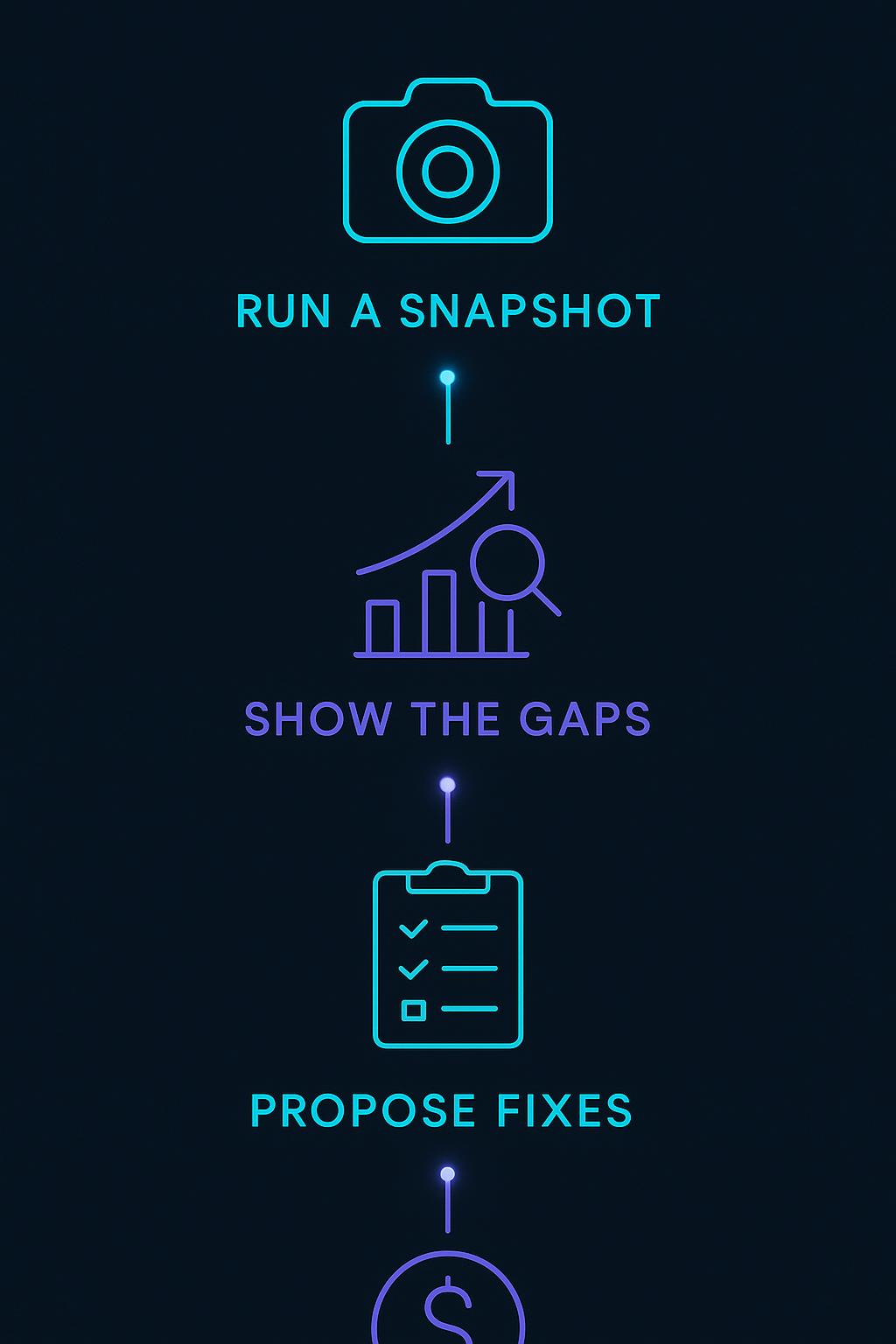
A one-time AI visibility snapshot gives a client a clear, documented picture of how — and whether — their brand appears when AI engines respond to queries relevant to their category. It benchmarks them against two or three competitors. It identifies which platforms mention them, which ignore them, and what the quality and context of those mentions looks like.
The snapshot has three commercial properties that make it an ideal opener. First, it is low-stakes: the prospect is not being asked to commit to a retainer before they have seen the problem. Second, it is almost always revealing — most brands have never looked at this data, which means the snapshot reliably surfaces something worth acting on. Third, it creates a baseline, and baselines demand follow-up.
For agencies running this motion, the workflow is straightforward: use a free AI visibility snapshot to generate the initial report on a prospect's domain, add a brief interpretive layer, and present it as a standalone deliverable. The goal is not to explain everything in session one. The goal is to show the client something they have never seen and let the data do the persuasion.
Showing the Proof: Competitive Visibility as the Narrative
Numbers without context do not move clients. The narrative that does move them is competitive: your brand is visible on these platforms; your closest competitor is more visible on those ones; here is what that looks like in practice.
When an AI engine responds to a category query by naming a competitor and omitting your client, that is a concrete, demonstrable problem. It is not abstract. It is not a prediction. It happened, and you can show the transcript.
The competitive angle also sidesteps the "does AI search really matter for us?" objection. It reframes the question: whether or not your client believes AI search matters in aggregate, they almost certainly care that a rival is being cited and they are not.
For agencies who want to show clients what improvement looks like in practice — not just in theory — a real before-and-after case study illustrates the trajectory a structured optimisation effort can produce. The point is not that every client will replicate that arc; it is that the arc is measurable, which means progress is demonstrable, which means the engagement has a defined shape.
Building the Recurring Revenue Layer
The snapshot is the entry point. The recurring value is in monitoring and recommendations.
AI engine outputs are not static. A brand that is well-cited today may be less prominent next month if a competitor publishes more authoritative content, if a platform's training corpus shifts, or if the brand's own digital presence develops gaps. This volatility is not a flaw in the product narrative — it is the justification for a monitoring retainer.
A well-structured ongoing engagement typically includes three components. The first is continuous tracking: is the client being mentioned across the AI platforms that matter to their category? Is that trend improving or deteriorating? The second is competitive surveillance: how is the client's share of AI-generated mentions moving relative to key rivals? The third is a prioritised recommendations layer: given the current visibility profile, what are the highest-leverage interventions — structured content, schema improvements, citation-building — that are most likely to improve the signal?
This last element is where the agency earns its margin. The platform can surface and rank recommendations. The agency's job is to translate them into a roadmap the client can action, and then to action it.
The renewal conversation is built into the model. Every monthly report shows movement, which either confirms the strategy is working or creates a clear brief for the next intervention. There is no natural endpoint, because AI platform outputs will keep evolving.
Positioning This to Your Clients
A few framing notes worth keeping in mind as you build this service line.
Avoid outcome guarantees. You cannot promise a client that they will be named in ChatGPT responses to a given query. No one can. What you can promise is that their visibility profile will be rigorously measured, that gaps will be identified, and that recommendations will be prioritised by expected impact. That is a credible, defensible promise. Guaranteed rankings are not.
Lead with measurement, not jargon. Most clients do not need to understand how large language models work. They need to understand that AI engines are now influencing how buyers discover and evaluate vendors in their category, and that their current visibility in those engines is unknown and therefore unmanaged. The audit makes it known. The retainer keeps it managed.
Price the snapshot as a discovery engagement, not a loss leader. Agencies that give away the snapshot entirely sometimes struggle to get credit for the work when the client moves to a retainer. A nominal fee — or a clear cost-to-upgrade framing — positions the snapshot as professional work product, not a sales tool.
Starting the Motion
The practical starting point is to run the audit on a prospect before the first meeting. Pull a free AI visibility snapshot on their domain, benchmark it against their two most obvious competitors, and walk into the conversation with a populated report rather than a pitch deck. The difference in reception is significant.
Agencies that have built a reliable new-service motion around AI visibility tend to describe the same experience: the data surprises almost every client, and surprised clients ask what to do next. That question is the beginning of the engagement.
Q: How is AI visibility different from traditional SEO rankings?
A: Traditional SEO measures where a page ranks in a list of search results. AI visibility measures whether and how a brand is mentioned when AI engines compose direct answers to queries. The mechanics are different — there are no ranked positions in a conventional sense — and the optimisation levers are different too. Structured content, brand authority signals, and citation patterns matter more than keyword density or page-speed alone.
Q: Do clients need to understand AI search to buy this service?
A: No. The most effective client conversations focus on competitive exposure rather than technical mechanics. If a client's category rivals are being named in AI-generated answers and the client is not, that is a concrete gap with commercial implications. The agency's job is to measure that gap and help close it — the client does not need to understand how the underlying models work.
Q: How often should AI visibility monitoring run?
A: At minimum, monthly. AI engine outputs can shift meaningfully in response to new content published by competitors, changes in how a platform weights certain source types, or updates to the client's own digital presence. Monthly monitoring gives enough resolution to detect meaningful trends without generating noise. For higher-velocity categories or actively contested brand terms, more frequent monitoring may be warranted.
Q: Can smaller agencies run this service without a dedicated analyst?
A: Yes. The core workflow — snapshot, interpret, present, monitor — does not require deep technical expertise when the measurement platform handles the data collection and scoring. The agency's value is in the interpretive and strategic layer: explaining what the data means for this client in this category, and translating recommendations into a prioritised action plan. That is a consulting skill, not an engineering one.