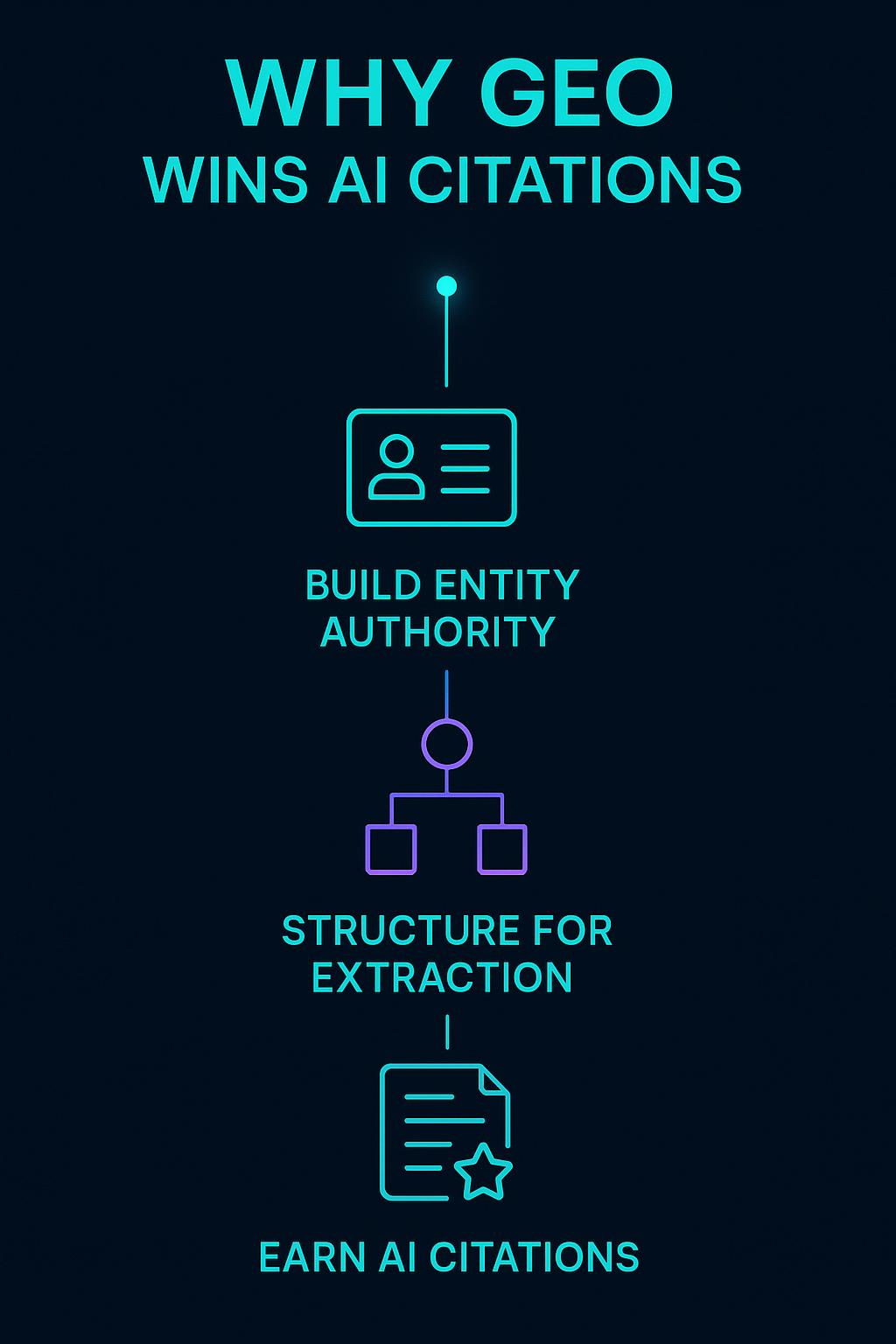
Why GEO Beats SEO for AI Citations: A Brighttech Field Test
A practical case study of measuring AI-engine citation lift after restructuring brighttech.co.za with GEO patterns — schema, FAQ blocks, entity clarity, and authoritative source seeding.
A Field Test, Not a Theory
Most arguments about GEO versus SEO stay abstract. This one doesn't. We took a single live website — brighttech.co.za, a co-located demo brand — ran Apex's automated audit-and-fix loop against it, and re-measured. The site's AI-readiness score moved from 62 to 93 in April 2026.
This is the story of what changed, and why those changes matter for getting cited by AI answer engines in a way traditional SEO work simply does not capture.
The exercise was deliberately narrow and honest: hold the editorial content constant, change the structure, and see whether a generative engine optimization fix loop moves a site's machine-readiness — the foundation a language model needs to retrieve, parse, and quote a brand.
The Baseline: A Score SEO Would Call "Fine"
At the start, brighttech.co.za was not broken. It loaded, it ranked for its own name, and a conventional SEO checklist would have waved it through. But its readiness score sat at 62 — a passing grade that hides a real problem: the things that make a page rankable are not the same things that make it quotable.
A search crawler tolerates ambiguity. It can rank a page on backlinks and keyword relevance even when the page never states, in plain machine-readable terms, who the brand is, what it does, or which claims are load-bearing. A language model has no such tolerance. When it assembles an answer, it pulls structured facts, named entities, and self-contained statements. If those aren't present, the brand is simply absent from the answer — no matter how well it ranks.
That gap is what the 62 represented: SEO-healthy, AI-illegible.
What the Fix Loop Actually Changed
Apex grades a site across five readiness signals — structure, schema, clarity, metadata, and accessibility — and the fix loop targets each one. None of these changes touched the message of the site. They changed how a machine reads it.
- Schema and structured data. Organization, Product, and FAQ schema were added so engines can resolve what this brand is without inferring it from prose. Structured data is the highest-leverage GEO change because it converts implicit context into explicit, quotable facts.
- Entity clarity. The brand, its category, and its key claims were stated in subject position — "BrightTech is…", "BrightTech provides…" — so a model can lift a sentence verbatim instead of paraphrasing around uncertainty.
- Citation shape. Long, hedged paragraphs were restructured into self-contained, factual statements that survive being quoted out of context — the core idea behind answer engine optimization.
- Metadata and freshness. Titles, descriptions, and timestamps were corrected so retrieval layers can date and categorise the content. Recency is a quiet but real signal in how often a source gets pulled.
- Technical accessibility. Render-blocking and crawl-path issues were resolved so the parseable content is actually reachable. A page an engine can't fully load is a page it can't cite.
Every one of these is a GEO move. None of them is what an SEO audit would have prioritised first.
The Result: 62 → 93
After the loop, the readiness score reached 93 — a +31 lift on the same content.
| Before | After | |
|---|---|---|
| AI-readiness score | 62 | 93 |
| Structured data | minimal | Organization + Product + FAQ |
| Entity statements | implicit | explicit, subject-position |
| Content shape | hedged prose | extractable statements |
The score is a proxy. It measures how ready a page is to be parsed and quoted — not a guaranteed citation count, and we won't pretend otherwise. But that readiness is the precondition for everything downstream. An engine cannot cite what it cannot cleanly read, and a 31-point jump in machine-legibility is the difference between a brand that is available to be quoted and one that is invisible at synthesis time.
Why GEO "Beats" SEO Here
The crux, stated precisely: GEO does not replace SEO, and "beats" is about fit for a specific outcome, not superiority in general.
Traditional SEO optimises for a ranking algorithm that serves a human who will click. Its unit of success is a position on a page someone scrolls. That work remains valuable — but it is indifferent to whether a machine can extract your facts, because human readers fill the gaps that crawlers tolerate.
GEO optimises for a language model that synthesises an answer the user may never click past. Its unit of success is presence inside that answer — being named, framed, and quoted. The fixes that move it are structural and machine-facing: schema, entities, extractable statements, freshness.
On brighttech.co.za the SEO fundamentals were already in place, and the brand was still under-equipped for AI citation. It took the GEO fix loop — not more link-building — to close that gap. That is the entire argument, reduced to one site and one number: for the specific job of getting cited by AI answer engines, GEO-oriented work moves a needle that SEO leaves untouched.
What This Means For Your Brand
If your site ranks well but you have never checked how an AI engine actually reads it, you may be sitting on a brighttech.co.za-shaped gap — SEO-healthy, AI-illegible — without knowing it. The fixes are not exotic: structured data, plain-language entity statements, and content shaped to be quoted. The hard part is measuring the gap in the first place.
That measurement is what an AI visibility audit is for. Run one against your own domain, compare the readiness score to what you'd expect from your SEO standing, and the gap — if there is one — tends to be wider than teams assume.
Take the Next Step
If you want to see where your brand currently stands across AI answer engines, ApexGEO offers a free AI visibility snapshot that shows where you are cited, where you are absent, and where the largest opportunities lie. Get your free AI visibility snapshot and start measuring what traditional rank trackers cannot show.
Q: What is an AI-readiness score?
A: An AI-readiness score measures how prepared a page is to be parsed, retrieved, and quoted by a language model when it assembles an answer. It grades signals like structured data coverage, entity clarity, content extractability, metadata accuracy, and technical crawlability — the factors that determine whether an engine can cleanly cite a brand, independent of how well the page ranks in traditional search.
Q: Why did brighttech.co.za score 62 before the fix loop?
A: The site passed conventional SEO checks — it loaded correctly, ranked for its own name, and had no major technical errors. But it lacked machine-readable signals: there was minimal structured data, entity statements were implicit rather than explicit, and content was written in hedged prose that engines struggle to quote verbatim. SEO health and AI-readiness measure different things, and the 62 reflected the gap between them.
Q: What specific changes moved the score from 62 to 93?
A: Five categories of changes: adding Organization, Product, and FAQ schema markup; restating brand identity in explicit subject-position sentences; restructuring hedged paragraphs into self-contained, quotable statements; correcting titles, descriptions, and timestamps for accurate retrieval; and resolving render-blocking and crawl-path issues so the content is fully reachable. No editorial content was changed — only structure and machine-facing signals.
Q: Does a higher AI-readiness score guarantee more citations?
A: No. The score is a proxy for how ready a page is to be parsed and quoted — it is a necessary condition, not a sufficient one. A brand still needs topical relevance, domain authority, and cross-platform presence to win citations in competitive categories. But a brand with a low readiness score cannot be cited cleanly regardless of those other factors, so the score is the right starting point for diagnosis.
Q: Can I run this kind of audit on my own site?
A: Yes. An AI visibility audit grades your site across the same signals — structure, schema, clarity, metadata, and accessibility — and surfaces the specific gaps. Running one against your own domain and comparing the readiness score to your expected SEO standing is the fastest way to identify whether you have a brighttech.co.za-shaped gap.
Q: Do GEO improvements help or hurt traditional SEO?
A: They help. Schema markup, clear entity statements, faster page load, and correct canonical tags all improve traditional SEO signals as well. The fix loop targets machine-legibility, and search crawlers benefit from the same clarity that language models require. GEO work is additive — it does not require rolling back anything SEO has established.