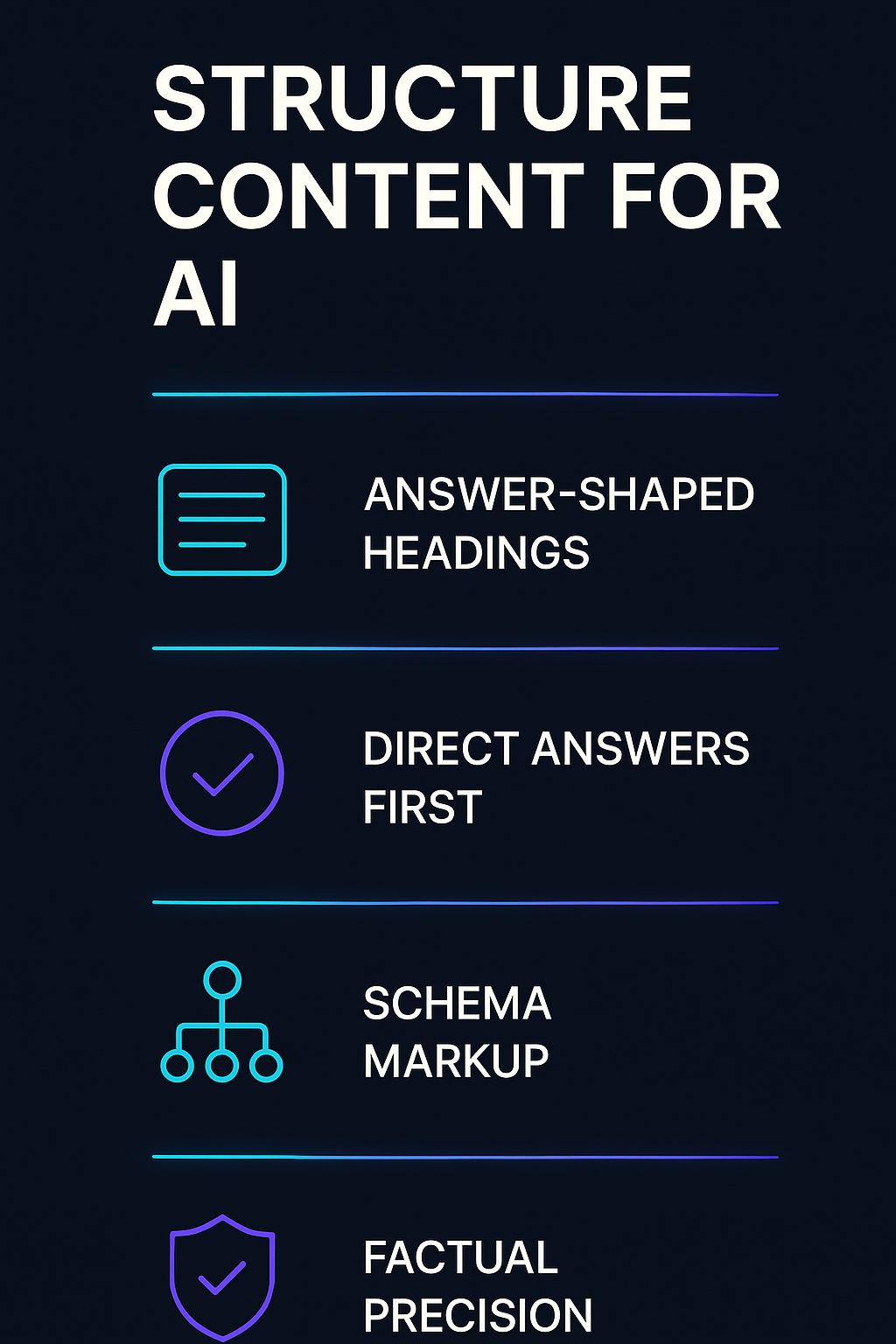
How to Structure Content for AI Citation: The Technical Playbook
Getting cited by AI search engines is not random. The engines that power ChatGPT Browse, Perplexity, Google AI Overviews, and Claude have consistent, learnable preferences for how content is structured. This guide breaks down the exact patterns that maximize citation probability....
How to Structure Content for AI Citation: The Technical Playbook
Getting cited by AI search engines is not random. The engines that power ChatGPT Browse, Perplexity, Google AI Overviews, and Claude have consistent, learnable preferences for how content is structured. This guide breaks down the exact patterns that maximise citation probability.
The Anatomy of a Citable Answer
When an AI engine generates an answer citing your brand, it has done three things:
- Retrieved your content (via crawl, RAG, or training data)
- Identified a passage as relevant to the query
- Decided to attribute that passage to your domain
Your content controls steps 2 and 3. Step 1 is solved by standard SEO (crawlability, sitemap, domain authority).
What "Relevant" Means to a Language Model
Relevance in a language model context is semantic, not keyword-based. The query "what software tracks AI brand mentions" and the query "how to monitor my brand on ChatGPT" are treated as semantically equivalent. Your content does not need to contain the exact query words — it needs to cover the concept.
Practical implication: write for concepts, not keyword variants. One comprehensive article on "AI brand monitoring" outperforms three thin articles on "ChatGPT brand tracking," "Perplexity brand mentions," and "AI search brand visibility."
The Answer-Ready Structure
Lead-With-Answer Paragraphs
Do not open articles with context-setting preambles. Lead with the answer.
Avoid: "Brand monitoring is a complex topic that requires understanding multiple dimensions. In this guide, we will explore why it matters..."
Use: "AI brand monitoring tracks how often and how accurately your brand appears in ChatGPT, Perplexity, Gemini, and other AI engine responses. It measures citation frequency, sentiment, and share-of-voice versus competitors."
The second version is citable. The first is not.
Explicit Q&A Sections
Every substantive article should have an FAQ section structured as literal questions and answers. This serves two purposes:
- Engines extract FAQ content as FAQPage JSON-LD candidates, which directly improves how structured data is presented
- Generative engines prioritise self-contained Q&A pairs over prose passages when answering question-format queries
Keep each answer fully self-contained — readable without needing the article body for context.
Data Points With Sources
Generative engines strongly prefer specific, cited statistics over vague claims:
Avoid: "Many brands are seeing results from GEO optimisation."
Use: "According to [a named, verifiable industry study], brands with structured FAQ content were cited noticeably more often in AI answers than those without." — always attribute the specific source you are citing; never invent a statistic or a study.
If you do not have third-party data, use your own: product usage metrics, platform-aggregated statistics, customer outcome data. First-party data with attribution is treated as authoritative.
Concept Clusters, Not Isolated Pages
AI engines build a picture of your domain from multiple pages. A single well-optimised page gets you one citation. A cluster of 8–10 pages that cover a topic from multiple angles (overview, comparison, use cases, technical guide, FAQ, case study) trains the engine to associate your domain with that concept category.
Build topical clusters. Each cluster needs: a pillar page (comprehensive overview), comparison pages, a how-to, and 2–3 supporting pieces. Internal links between cluster pages signal the semantic relationship.
Technical Implementation
JSON-LD Schema Markup
Every page should emit structured data. For blog posts: Article plus BlogPosting. For FAQ content: FAQPage. For comparison pages: ItemList or Review.
Apex GEO automatically emits all required JSON-LD on every blog post — including FAQPage extraction from heading-structured Q&A pairs.
Heading Hierarchy
Use a clean heading hierarchy: one H1 for the article title, H2 for main sections, H3 for subsections. AI engines use heading structure to segment content into citable passages. Pages that violate heading hierarchy are harder for engines to parse correctly.
Canonical and Freshness Signals
- Set a canonical link on every page
- Ensure the last-modified header reflects actual content updates, not deploy dates
- Add a lastmod field to your sitemap with the actual date content changed
- Update evergreen articles when the facts change — stale data reduces citation probability
Page Speed and Core Web Vitals
Slower pages are crawled less frequently and ranked lower in the retrieval layer that feeds AI engines. Aim for: LCP under 2.5 seconds, CLS under 0.1, INP under 200ms. Server-side rendered content significantly outperforms client-rendered alternatives for both crawl and Core Web Vitals.
The Compounding Effect
Content optimisation for AI citation compounds over time. Each article you publish that follows these patterns gets indexed, gets sampled by AI engines, increases your entity authority score, and makes future articles more likely to be cited.
Brands that start this flywheel early embed themselves into AI model fine-tuning data — a position that takes years for competitors to displace.
Take the Next Step
If you want to see where your brand currently stands across AI answer engines, ApexGEO offers a free AI visibility snapshot that shows where you are cited, where you are absent, and where the largest opportunities lie. Get your free AI visibility snapshot and start measuring what traditional rank trackers cannot show.
Q: How many FAQ questions should I include per article?
A: Include 3–6 FAQ questions per article, covering the most common questions a reader would have after reading the main content. Quality matters more than quantity — each question should be genuinely useful and the answer should be fully self-contained. Avoid repeating information already prominent in the article body.
Q: Should FAQ content use schema markup even if the page already has Article schema?
A: Yes. FAQPage and Article schemas can coexist on the same page. Google and other engines support multiple schema types. FAQPage schema significantly increases the probability of appearing in AI-generated answers because it provides pre-extracted Q&A pairs the model can use directly.
Q: Does content length affect AI citation probability?
A: Yes, but not linearly. Longer articles (1,500–3,000 words) outperform short ones because they cover a topic with enough depth to satisfy multiple query variants. However, individual answer passages should be concise (100–250 words). The pattern that works: a comprehensive long-form article where each section contains a standalone, citable answer passage.
Q: How often should I update existing articles for GEO?
A: Update articles with changed facts immediately. Update evergreen articles that are underperforming every 3–6 months — adding new data, current statistics, and additional FAQ pairs. AI engines weigh recency, so a well-structured article updated 6 months ago will often outperform a more comprehensive but 2-year-old article.