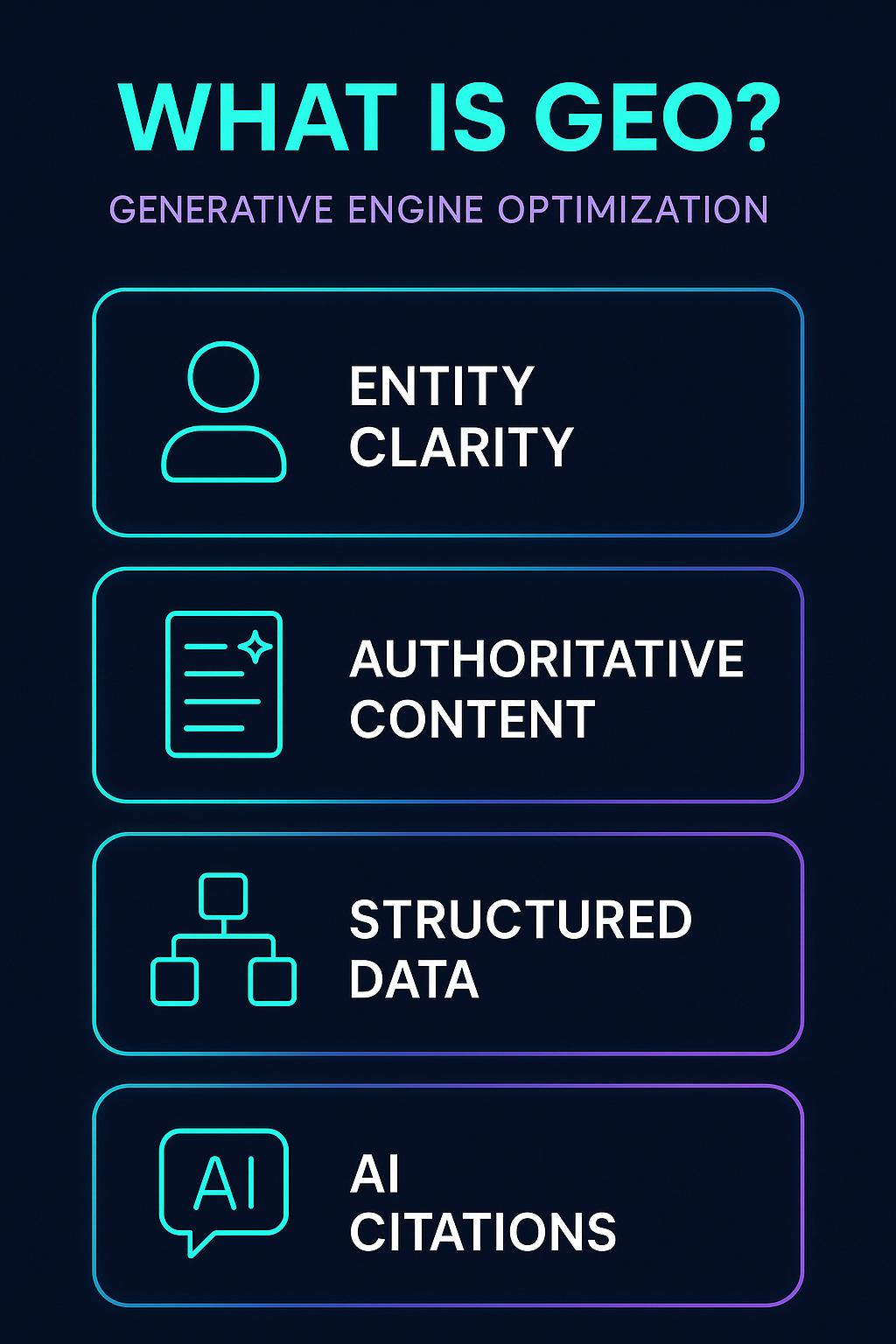
What Is GEO? The Complete Guide to Generative Engine Optimization
Generative Engine Optimization (GEO) is the practice of making your brand, content, and website easy to discover, cite, and recommend by AI-powered search engines — including ChatGPT, Perplexity, Google AI Overviews, Claude, Grok, and Copilot....
What Is Generative Engine Optimisation?
Generative Engine Optimization (GEO) is the practice of making your brand, content, and website easy to discover, cite, and recommend by AI-powered search engines — including ChatGPT, Perplexity, Google AI Overviews, Claude, Grok, and Copilot.
Traditional SEO gets you ranked on a page of blue links. GEO gets you cited inside the answer itself.
Why GEO Is Different From SEO
SEO optimizes for crawlers that index pages and return lists. Generative engines do something fundamentally different: they synthesise information from multiple sources and generate a coherent answer. Your goal shifts from ranking position to citation probability.
A user asking "What's the best GEO platform for B2B SaaS?" in Perplexity won't see ten blue links. They'll see a two-paragraph answer — and only the brands inside that answer get the click.
The Citation Gap Is Real
AI answers tend to concentrate attention on a small set of frequently-cited brands per category — the visible few capture most of the recommendations, and everyone else is effectively invisible in the answer. Brands that rank well in traditional search but are absent from AI citation pools risk losing discovery as AI search adoption grows, because a synthesised answer rarely lists a tenth option the way a results page does.
The Five Pillars of GEO
1. Structured Authority Signals
AI engines weight sources with clear entity signals: Organization schema markup, consistent NAP (name/address/phone) across the web, Wikipedia/Wikidata entries, verified profiles on G2/Capterra/Trustpilot, and cited mentions in high-authority publications.
2. Answer-Ready Content
Write for questions, not keywords. Structure every important concept as a question-answer pair. Use explicit heading patterns so AI engines can extract clean answers. Keep answers under 200 words — engines truncate longer responses.
3. Semantic Density
Repeatedly co-locate your brand name with the problem it solves. If you want to be cited for "GEO platform," the phrase "GEO platform" should appear in your brand's context consistently across your site, PR, and third-party coverage — not just once in a meta description.
4. Freshness and Crawlability
Generative engines favour recently-updated content. Publish at minimum 2–4 articles per month. Ensure your sitemap.xml is clean, your canonical tags are correct, and you have no orphan pages blocking crawl.
5. Multi-Platform Presence
Perplexity draws from Reddit, LinkedIn, G2, and news. ChatGPT draws from its training data plus Bing. Claude (Pro Search) draws from web. No single channel wins every engine. Distribute your brand story across all of them.
How AI Engines Score Citations
When a generative engine evaluates whether to cite your brand, it runs an implicit scoring function across:
- Source authority (domain rating, backlink quality)
- Relevance match (semantic similarity to the user query)
- Recency (publication date, last-modified header)
- Cross-reference density (how many other authoritative sources mention your brand in the same context)
- Factual accuracy (engines increasingly validate claims against known facts)
Your brand needs a strong signal on all five dimensions to win the citation.
Measuring GEO Performance
Unlike SEO's click-through rate and position metrics, GEO introduces a new measurement vocabulary:
| Metric | Definition |
|---|---|
| Mention Rate | % of relevant queries where your brand appears in the AI answer |
| Citation Share | Your mentions divided by total brand mentions in your category |
| Sentiment Ratio | Favourable : neutral : unfavourable citation framing |
| Platform Coverage | Number of AI engines that cite you vs. total monitored |
| Answer Position | Whether you appear in the first sentence, paragraph, or as a footnote |
Apex GEO tracks all of these automatically, sampling queries across its monitored platforms on a recurring cadence — weekly on entry plans, daily on higher tiers.
Take the Next Step
If you want to see where your brand currently stands across AI answer engines, ApexGEO offers a free AI visibility snapshot that shows where you are cited, where you are absent, and where the largest opportunities lie. Get your free AI visibility snapshot and start measuring what traditional rank trackers cannot show.
Q: What is the difference between GEO and SEO?
A: SEO optimises content for traditional search engines that return ranked lists of links. GEO optimises for AI-powered search engines (like ChatGPT, Perplexity, and Google AI Overviews) that generate direct answers citing specific brands and sources. GEO focuses on citation probability rather than ranking position.
Q: How long does it take to see GEO results?
A: Most brands see measurable improvements in mention rate within 6–12 weeks of implementing GEO fundamentals (structured schema, FAQ content, entity signals). Citation share improvements in competitive categories typically take 3–6 months as AI engines resample updated content.
Q: Do I need to abandon SEO for GEO?
A: No. GEO and SEO are complementary. Strong SEO signals (domain authority, quality backlinks, technical health) directly improve GEO performance because AI engines use many of the same trust signals. The key addition is answer-ready content structure and multi-platform entity building that SEO alone does not cover.
Q: Which AI engines should I prioritise for GEO?
A: Prioritise based on your audience. B2B SaaS should focus on Perplexity (used heavily by technical buyers) and ChatGPT (widest enterprise adoption). Consumer brands should add Google AI Overviews (highest volume). Track all platforms with a GEO monitoring tool so you can identify where your citation gaps are largest.