Leading AI Visibility Tools: A 2026 Buyer's Guide
The tooling landscape for AI visibility has matured quickly. This 2026 buyer's guide covers what to evaluate, how the main categories compare, and what a purpose-built platform actually does differently.
Why AI Visibility Tooling Has Become Its Own Category
For most of the past two decades, "search tool" meant one thing: software that tracked keyword positions on Google, reported crawl health, and surfaced backlink data. That category is mature, well-populated, and genuinely useful. It has not become obsolete. What has changed is the environment around it.
AI answer engines — ChatGPT, Claude, Gemini, Perplexity, Grok, DeepSeek, and others — now sit at the front of many discovery journeys. When a user asks a substantive question, they often receive a synthesised answer directly, without clicking through to any website. The brand that gets cited in that answer, and the brand conspicuously absent from it, each experience a discovery outcome that a rank-tracking dashboard cannot see or measure.
This gap is not a minor instrumentation problem. It is a structural difference in how discovery works. AI visibility is not a ranking position — it is presence, framing, sentiment, and frequency within generated responses across multiple platforms, each of which reasons slightly differently about the same query. Measuring it requires a different kind of tool entirely.
That is why, in the past two years, a distinct tooling category has emerged: platforms built specifically to monitor, audit, and improve brand visibility inside AI-generated answers. This guide explains what that category looks like in 2026, what capabilities actually matter, and how to evaluate the options without getting distracted by surface-level features.
From SEO Dashboards to AI Visibility Platforms
What Traditional SEO Tools Miss
A conventional SEO dashboard answers questions like: where does this page rank for this keyword? How many backlinks point to this domain? Is the site crawlable? These are legitimate, important questions. The tools built to answer them are sophisticated and well-designed.
They are not, however, designed to answer: when a user asks a question that your product solves, does an AI answer engine cite your brand? Is the framing neutral, positive, or negative? Are competitors mentioned where you are absent? Is your brand cited consistently across ChatGPT and Gemini, or does your presence vary significantly between platforms?
The reason traditional tools miss these questions is architectural. They are built around the structure of search results pages — a list of links with associated metadata. AI answer engines produce prose, not lists. The citation may be embedded mid-paragraph. The source may or may not be linked. The brand may be mentioned by name, described generically, or substituted with a competitor. None of this is legible to a rank tracker.
The Shift in What Needs Monitoring
Generative engine optimization and answer engine optimization share a measurement requirement that is fundamentally different from SEO: you need to query AI engines directly, repeatedly, and across many relevant prompts, then analyse the responses for brand presence. The signal is not a number handed back by an API — it is language that must be parsed, classified, and stored over time.
This requires infrastructure that traditional SEO tools were not built to support: automated prompt dispatch, multi-engine querying, response parsing for entity mentions, sentiment classification, historical persistence, and cross-engine comparison. Platforms built for AI visibility have this infrastructure at their core. Tools retrofitted from an SEO base tend to offer it as a thin add-on, with the limitations that implies.
Capabilities That Actually Matter
Persistent Monitoring vs One-Off Checks
The single most important distinction between categories is whether the tool monitors continuously or delivers a one-time report.
A one-off check tells you how your brand appears in AI responses today, for the prompts tested, on the engines queried. It is a useful baseline. It is not a measurement programme. AI answer engines update their knowledge, retrieval configurations, and synthesis behaviour on cycles that are not publicly disclosed. A brand's citation profile can shift meaningfully between checks without any deliberate change on either side.
Persistent monitoring — running a structured set of prompts across relevant engines on a recurring cadence and storing every response — gives you a time-series view. You can see whether a content change improved citation frequency. You can detect when a competitor's coverage expands at your expense. You can distinguish a genuine trend from a one-day anomaly. This is the difference between a thermometer reading and a temperature chart.
Actionable Recommendations vs a Bare Score
Knowing your current AI visibility score is less useful than knowing which specific changes would improve it. A score without a fix list is an observation, not a programme.
The most capable platforms in this category translate gaps identified in monitoring into specific, ranked recommendations: which schema markup is missing, which entity signals are inconsistent, which content gaps correspond to queries where competitors are cited and you are not. Ranking those recommendations by expected impact allows a team to work in priority order rather than guessing which fix matters most.
This is a harder capability to build than a score. It requires the platform to maintain a model of what drives citation across different engines, and to apply that model to each brand's specific profile. It is also the capability that most clearly separates purpose-built platforms from lightweight alternatives.
Multi-Engine Coverage and Engine Parity
Not every AI answer engine reasons about brands in the same way. ChatGPT, Claude, Gemini, Perplexity, Grok, and DeepSeek each have different training data cutoffs, retrieval configurations, and synthesis styles. A brand can be well-cited on one engine and essentially invisible on another — sometimes for structural reasons, sometimes reflecting differences in how each engine weights authority signals.
A tool that monitors only one engine gives you a partial picture. Coverage across all major platforms allows you to identify which engines represent your strongest presence, where the largest gaps are, and whether your optimisation efforts are lifting performance broadly or unevenly.
Engine parity also matters within a monitoring session: if the tool queries different engines at different frequencies, or with different prompt sets, the comparisons become difficult to interpret. Consistent methodology across engines is the foundation of meaningful cross-platform analysis.
Audit Depth and Entity Analysis
Beyond monitoring what AI engines say about your brand, understanding why they say it — or why they don't — requires a different kind of analysis. Site audits for AI visibility examine the technical and structural factors that affect how well AI systems can understand and cite your content.
This includes entity consistency: is your brand described in the same terms across your own site, third-party sources, and structured data? It includes schema markup coverage: do your pages use the vocabulary that helps AI systems understand what you offer and who you are? It includes content structure: are your core claims written in ways that can be extracted and attributed cleanly?
The audit layer is distinct from the monitoring layer. Monitoring tells you what is happening; the audit tells you what structural factors are contributing to it. Together they provide the diagnostic picture needed to run a genuine improvement programme.
How the Categories Compare
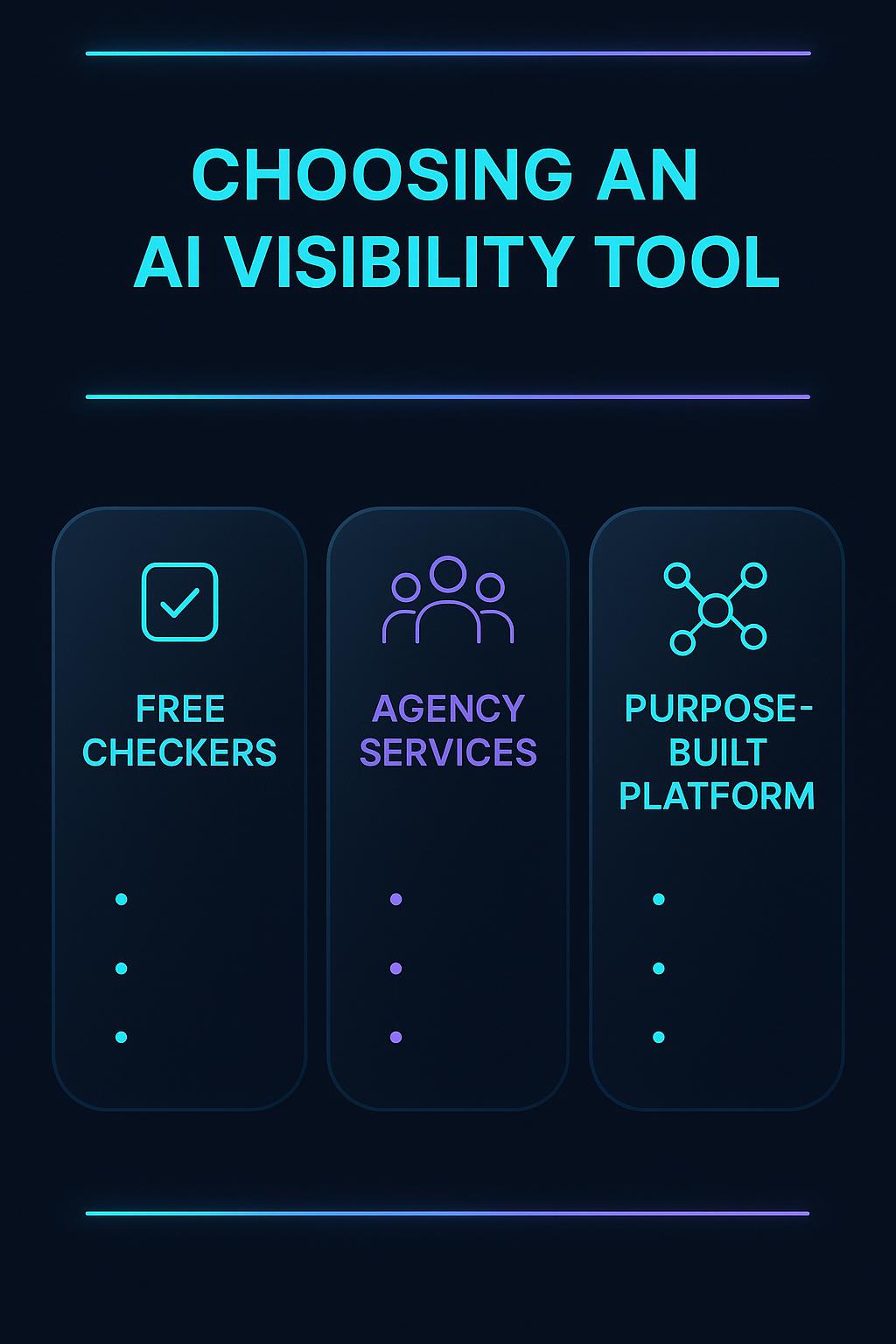
| Dimension | Lightweight free checkers | Strategy / agency services | Purpose-built platform (e.g. ApexGEO) |
|---|---|---|---|
| Engine coverage | Typically one or two engines | Variable; depends on agency workflow | Broad and consistent across all major engines |
| Data persistence | One-off snapshot; no history | Report-based; history tied to engagement | Continuous monitoring with persistent time-series data |
| Actionable fixes | Score or summary only | Recommendations in written reports | Structured, prioritised fix list tied to expected impact |
| Audit depth | Surface-level or absent | Varies by practitioner | Technical + entity + schema analysis built into the platform |
| Best for | Initial orientation, quick sense-check | Brands wanting advisory-led strategy work | Teams needing ongoing measurement and self-serve optimisation |
No single category is universally right. A brand starting its AI visibility journey may begin with a free checker simply to understand the current state. A business without internal technical capacity may find an agency service valuable for strategy. The limitation of lighter-weight approaches is not that they are wrong — it is that they are insufficient for sustained measurement, and AI visibility is not a problem you solve once.
Running a Brand Audit from Data to Citation
Start with the Monitoring Baseline
Before attempting to improve AI visibility, establish what you are starting from. Run a structured set of prompts — questions that real users would ask in your category, across all major AI engines — and record which brands are cited, how often, and in what framing. This is your baseline.
The quality of this baseline depends on prompt design. Generic category questions ("what are the best tools for X?") give one signal; more specific, use-case-driven questions give another. A well-designed monitoring programme covers the range of ways a real prospect might discover your category, not just the obvious head queries.
Layer the Technical Audit
Once you have a monitoring baseline, run a technical site audit against the same brand profile. Examine entity consistency across your site and across third-party sources. Review schema markup coverage, particularly for your core offering, your organisation, and any author or expertise signals your content carries. Assess whether your key claims are written in a format that is attributable — specific, factual, clearly tied to your brand.
Gaps identified in the audit can often be mapped directly to gaps in the monitoring data. A brand with inconsistent entity signals tends to have inconsistent citation rates. A site with strong schema markup and clear factual content tends to perform better on engines that weight structured retrieval heavily.
Prioritise by Expected Impact
Not all fixes are equal. Schema markup for a page type that rarely appears in relevant queries is a lower priority than a fundamental entity consistency issue that affects how every AI engine understands your brand name. A platform that ranks recommendations by expected score impact lets your team focus effort where it is most likely to produce measurable change.
This prioritisation step is where the difference between a score and a structured recommendation list becomes concrete. A score tells you how far you are from where you want to be. A ranked fix list tells you how to get there.
ApexGEO's Approach
ApexGEO is built around three core surfaces — MONITOR, CREATE, and AUDIT — plus a Smart Recommendations Engine that connects what the monitoring finds to what your team should do next.
MONITOR dispatches queries across the six core AI answer engines (ChatGPT, Claude, Gemini, Perplexity, Grok, DeepSeek) plus Microsoft Copilot — seven engines total — on a structured cadence. Every response is stored, parsed for brand mentions, and added to the time-series record. You can see how your citation profile evolves over time, how you compare to competitors on specific query types, and which engines represent your strongest and weakest coverage.
AUDIT analyses your site and brand profile for the structural factors that AI systems use to understand and cite content — entity consistency, schema markup, content structure, factual precision. The output is a scored diagnostic rather than a list of generic recommendations; it reflects your specific profile against the requirements of the engines being monitored.
CREATE supports the content side of the programme: building or improving the brand-voice content that informs both AI visibility and traditional search performance. Content decisions informed by monitoring data — what queries your brand is absent from, what framing competitors use — are more targeted than content created in isolation.
The Smart Recommendations Engine pulls these surfaces together, ranking the specific fixes from your audit and monitoring data by expected impact on your overall AI visibility score. Rather than presenting a flat list of everything that could be improved, it surfaces the highest-leverage actions first.
None of this is presented as a one-time fix. Generative engine optimization is an ongoing programme, not a one-off audit. The platform is designed to support that cadence: monitoring runs continuously, recommendations update as your profile changes, and the historical record gives you evidence of what is working.
Starting with a Free Snapshot
If you are not yet running a structured AI visibility programme, the clearest first step is a baseline measurement. Understanding where your brand currently stands — which engines cite you, on what query types, and where the gaps are largest — gives you the data you need to prioritise the work.
ApexGEO offers a free AI visibility snapshot that does exactly this: it queries major AI answer engines across your category, surfaces citation data, and identifies where the most significant opportunities lie. There is no obligation and no configuration required beyond your brand domain.
Get your free AI visibility snapshot and start measuring what traditional rank trackers cannot show.
Q: What makes AI visibility tooling different from standard SEO tooling?
A: The core difference is what is being measured. SEO tools track positions on search result pages — a structured output that can be polled directly. AI answer engines return prose, and brand presence within that prose must be detected by querying the engines with real prompts, parsing the responses for mentions, and classifying the framing. This requires different infrastructure, different methodology, and different data persistence than a rank tracker is built to support.
Q: How often should AI visibility be monitored?
A: Continuous monitoring is preferable to periodic checks. AI answer engines update their retrieval configurations and synthesis behaviour on cycles that are not publicly disclosed, and brand citation profiles can shift without any deliberate action on your part. Monitoring on a fixed cadence — at minimum weekly, ideally more frequent for competitive categories — gives you the time-series data needed to detect trends, measure the impact of content changes, and identify competitive shifts early.
Q: Do I need to monitor every AI engine separately?
A: Yes, and the differences between engines matter. ChatGPT, Claude, Gemini, Perplexity, Grok, and DeepSeek each have different training data characteristics, retrieval configurations, and synthesis styles. A brand can be well-cited on one platform and largely absent on another. Monitoring across all major engines is the only way to understand where your audience is finding answers and where the gaps are largest.
Q: Is AI visibility monitoring relevant if my audience is not yet using AI search heavily?
A: Adoption of AI answer engines is accelerating across most professional and consumer categories, and the brands that establish citation presence now are likely to benefit from that early position as usage grows. More immediately, the factors that improve AI citation — entity clarity, authoritative content, schema markup, factual precision — also improve performance in traditional search, so the investment is not speculative. It supports existing channels while building presence in emerging ones.
Q: What is the relationship between answer engine optimization and schema markup?
A: Schema markup is one of several factors that affect answer engine optimization performance, but it is not sufficient on its own. It helps AI systems understand what your content is about, what type of entity you are, and how your claims relate to established concepts. A well-marked-up page that lacks factual depth or entity consistency will still underperform. Schema markup is most valuable as part of a broader programme that also includes content quality, entity signal consistency, and topical authority — not as a standalone fix.
Q: What does "entity clarity" mean in practice?
A: Entity clarity refers to how consistently and unambiguously your brand is described across all the signals AI systems use to understand it — your own site content, structured data, third-party sources, and press. A brand with multiple naming conventions, inconsistent descriptions of its core offering, or sparse third-party mentions is less legible to an AI model than one that is described consistently across many authoritative sources. Improving entity clarity typically involves auditing your own content for consistency, ensuring your structured data reflects your current offering accurately, and building third-party coverage that reinforces your core positioning.
Q: Can a brand improve AI visibility without changing its website?
A: Website changes are often the most effective lever because they affect both AI citation and traditional search simultaneously. However, they are not the only lever. Third-party coverage — editorial mentions, directory listings, authoritative references to your brand by name — contributes meaningfully to how AI systems understand and cite you. A brand with limited on-site content can still improve its AI visibility by building external signals, though the combination of both is more effective than either in isolation.
Q: How is AI visibility different from traditional share-of-voice measurement?
A: Traditional share-of-voice measures how visible a brand is relative to competitors in paid media, social mentions, or search results. AI visibility share-of-voice measures how frequently a brand is cited in AI-generated answers relative to competitors on the same query set. The mechanics are different — you cannot buy position in an AI answer the way you can in paid search — but the strategic logic is similar: more of the available mind-share means more of the discovery opportunity. The difference is that AI share-of-voice is driven by authority, entity clarity, and content quality rather than by spend.