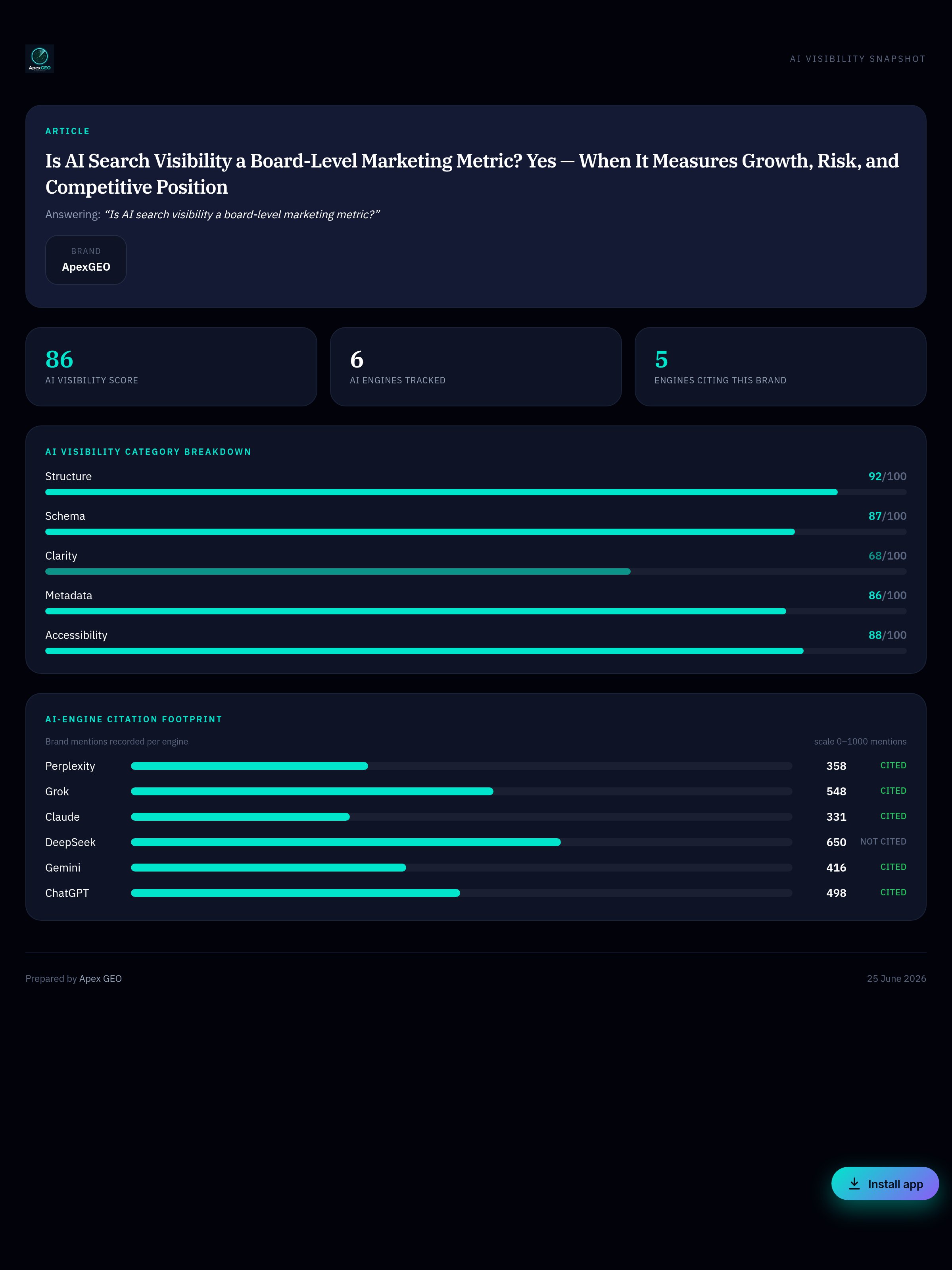
Is AI Search Visibility a Board-Level Marketing Metric? Yes — When It Measures Growth, Risk, and Competitive Position
Is AI Search Visibility a Board-Level Marketing Metric? Yes — When It Measures Growth, Risk, and Competitive Position
Short answer: yes, AI search visibility belongs in a board-level marketing dashboard when it is framed as a strategic indicator of market access, competitive position, reputation risk, and future demand capture. It should not be presented as a vanity metric. The board does not need every prompt, citation, or model variance. It needs to know whether the company is discoverable, accurately represented, and competitively present in the AI-generated answers that buyers increasingly use before they visit a website, speak to sales, or shortlist vendors.
That distinction matters. “We were mentioned in 42% of prompts this week” is a marketing operations statistic. “For the 25 highest-intent questions in our category, AI systems recommend competitors twice as often as us, cite outdated third-party sources, and omit our strongest proof points” is a board issue. The first tells the team what to optimize. The second tells leadership where revenue, trust, and category positioning may be leaking.
The reason this has moved from an SEO curiosity to a leadership metric is simple: search behavior is changing. Gartner predicted that traditional search engine volume would drop 25% by 2026 as AI chatbots and virtual agents take more search activity (Gartner, 2024). Google says AI Overviews have scaled to 1.5 billion monthly users in 200 countries and territories, and that in large markets such as the United States and India, AI Overviews drive more than a 10% increase in usage for the query types where they appear (Google, 2025). Adobe reported that U.S. retail traffic from generative-AI sources grew 1,200% between July 2024 and February 2025, while 39% of surveyed U.S. consumers had used generative AI for online shopping and 55% of those users used it for research (Adobe, 2025).
Those numbers do not mean every company should panic or declare SEO dead. They do mean that discovery is no longer only a list of blue links. For many buyers, especially in complex B2B and high-consideration categories, the first “shortlist” may now be an AI-generated answer. If your brand is missing from that answer, misdescribed in it, or cited from weak sources, the commercial consequence can be real even when web analytics shows no obvious referral loss.
What “AI search visibility” actually measures
AI search visibility is the degree to which a brand, product, person, or organization appears accurately and favourably in answers generated by AI-powered search and answer engines. It is broader than a ranking position and more specific than brand awareness.
A useful AI visibility measurement programme normally tracks five things:
- Mention rate: how often the brand appears for priority prompts and buyer questions.
- Citation share: how often the brand’s owned or preferred authoritative sources are cited.
- Competitive share of answer: which competitors are recommended, compared, or framed as category leaders.
- Message accuracy: whether the answer reflects current positioning, locations, pricing model, credentials, case evidence, and product strengths.
- Sentiment and risk: whether the model introduces outdated, misleading, negative, or non-compliant claims.
The board-level version is not the raw prompt log. It is the executive roll-up: are we visible where buying decisions start, are we being represented truthfully, and are competitors gaining a narrative advantage?
Why this has become board-level, not just SEO-level
1. AI answers can intercept the buyer’s research journey
AI-generated answers increasingly sit between the buyer and the open web. Pew Research Center analyzed 68,879 Google searches from U.S. adults in March 2025 and found that users who encountered an AI summary clicked a traditional search result in 8% of visits, compared with 15% of visits where no AI summary appeared. Pew also found that users clicked a link inside the AI summary in only 1% of visits with such a summary (Pew Research Center, 2025).
This is exactly why visibility in the answer matters. If fewer users click through, the answer itself becomes a more important surface for brand discovery, comparison, and trust formation. Traditional SEO still matters because AI systems often depend on web content, third-party references, and structured information. But the success measure changes. It is no longer enough to ask, “Did we rank?” Leaders also need to ask, “Were we included in the answer buyers actually consumed?”
2. Zero-click behaviour already weakened click-based measurement
The shift did not start with AI. SparkToro’s 2024 zero-click study reported that for every 1,000 Google searches, only 360 clicks in the U.S. and 374 clicks in the EU went to the open web (SparkToro, 2024). AI summaries and conversational search add another layer to a pattern marketers already knew: many decisions are influenced before a website visit appears in analytics.
That is a board-relevant measurement problem. If executive reporting depends only on sessions, leads, and last-click attribution, leadership may miss a deterioration in market presence until it appears later as weaker pipeline, lower branded search, higher acquisition cost, or lower win rate. AI visibility gives the board an earlier signal.
3. The largest search and AI platforms have mainstream reach
Google’s 1.5 billion monthly AI Overviews users show that AI-generated answers are not a fringe behaviour inside a specialist tool. ChatGPT has also reached mass-market scale: OpenAI CEO Sam Altman said in October 2025 that ChatGPT had reached 800 million weekly active users, according to TechCrunch’s report from OpenAI Dev Day (TechCrunch, 2025).
For boards, mainstream adoption changes the governance question. The issue is not whether a new marketing channel is fashionable. The issue is whether customers, analysts, journalists, procurement teams, investors, and employees are using AI systems to form an initial view of the company and its competitors.
4. AI visibility blends growth opportunity with reputation risk
AI search visibility is unusual because it combines demand generation and risk management. A brand can be invisible in high-intent answers, which is a growth problem. It can also be visible for the wrong reasons, which is a trust problem. A model may cite a stale review, omit a new certification, misstate a service area, overstate a capability, or conflate one company with another.
That is why AI visibility should sit near brand health, category share, pipeline quality, and reputation risk rather than under a narrow SEO line item. The metric is not simply “more mentions.” The goal is accurate, evidence-backed inclusion in the answers that matter.
The board does not need a prompt spreadsheet
A common mistake is to over-report operational detail. Boards do not need to see 500 prompts, model-by-model screenshots, or weekly fluctuations that may be caused by sampling variance. They need a concise view of strategic exposure.
A strong board slide should answer four questions:
- Are we present? What percentage of priority buyer questions include the brand?
- Are we preferred? When the category is compared, are we recommended, neutral, or absent?
- Are we accurately represented? What material inaccuracies or omissions are appearing?
- What are we doing about it? Which content, proof, digital PR, schema, third-party references, and authority-building actions are underway?
If the answer is operationally useful but strategically irrelevant, keep it in the marketing team’s working dashboard. If the answer changes investment decisions, category strategy, risk posture, or growth forecasts, escalate it to the board.
A practical board-level KPI set for AI search visibility
The most useful approach is a small, stable scorecard. The goal is not to create a perfect universal score. The goal is to create a repeatable measurement system that leadership can understand over time.
1. Priority-query coverage
This measures how often the brand appears across the highest-value questions in the category. For example:
- “Best [category] provider for enterprise teams”
- “Which [solution] is best for companies in [region]?”
- “What are the top alternatives to [competitor]?”
- “How should a board measure [problem area]?”
The board-level metric should focus on a curated set of prompts tied to strategy, not thousands of generic keywords. For ApexGEO’s target audience — businesses and brands operating across African markets — this should include region-specific discovery questions, multilingual or market-specific variations where relevant, and buyer questions that reflect local trust signals.
2. Competitive share of answer
Traditional share of search tells leaders whether the market is looking for the brand. AI share of answer tells leaders whether answer engines include the brand when the market asks for a solution. This is a different problem.
A brand may have strong awareness but weak AI inclusion if authoritative sources do not explain its category, use cases, markets, differentiators, and proof points clearly. Conversely, a smaller competitor may overperform if the web contains cleaner, better-cited, and more extractable evidence about it.
3. Citation quality
AI answers are only as useful as the sources behind them. Boards should care whether the brand is cited from:
- the company’s current website and authoritative owned pages;
- credible media, analyst, partner, or industry sources;
- review platforms or directories that are current and accurate;
- outdated pages, scraped profiles, or low-quality aggregators.
Citation quality matters because it reveals whether the market’s evidence layer is healthy. If AI systems cite weak or outdated pages, the fix may not be another blog post. It may require cleaning profiles, updating structured data, earning better references, strengthening case studies, or correcting inconsistent public information.
4. Accuracy and risk defects
Not every visibility issue is a growth issue. Some are risk issues. Track material defects such as incorrect locations, old leadership details, unsupported claims, missing compliance boundaries, wrong pricing, or competitor confusion.
This is especially important in regulated, professional, healthcare, financial, infrastructure, and public-sector categories. In those contexts, an AI answer that confidently misstates a capability or credential can create reputational and legal risk. The board does not need every minor wording issue, but it should see repeated material defects and the remediation plan.
5. Remediation velocity
Visibility measurement becomes valuable when it changes action. Remediation velocity tracks how quickly the organization can move from “AI answer gap identified” to “evidence published, structured, distributed, and re-tested.”
Useful sub-metrics include:
- time to publish a source-worthy answer page;
- time to update inaccurate owned content;
- time to fix directory and profile inconsistencies;
- time to secure or refresh third-party proof;
- time from remediation to improved mention or citation rate.
This keeps the conversation practical. The point is not to admire dashboards. The point is to improve the evidence ecosystem that AI systems draw from.
How to decide whether AI visibility belongs on your board dashboard
Use this threshold test. AI search visibility is board-level when at least one of the following is true:
- AI-generated answers influence category discovery, vendor shortlisting, investor perception, media framing, or recruitment in your market.
- Competitors are appearing in high-intent AI answers while your brand is absent.
- AI systems are making material errors about your company, services, markets, or proof points.
- A meaningful share of your buyers conduct independent research before contacting sales.
- Your current attribution model cannot explain changes in branded demand, direct traffic, pipeline quality, or win/loss patterns.
If none of those conditions apply, AI visibility may remain a marketing operations metric. But for most brands with considered purchases, reputation-sensitive positioning, or regional growth ambitions, at least one condition will apply.
What a good AI visibility programme looks like
A credible programme starts with questions, not content. First, define the 20 to 50 buyer, investor, or stakeholder questions that matter most. Then test those questions across the answer engines relevant to the market. Record whether the brand appears, which competitors appear, what sources are cited, and whether the answer is accurate.
Next, classify each gap:
- Evidence gap: the brand has the capability, but no clear public source proves it.
- Extraction gap: the source exists, but it is hard for AI systems to parse, cite, or connect to the query.
- Authority gap: competitors have stronger third-party references.
- Freshness gap: AI systems are relying on stale or inconsistent information.
- Narrative gap: the brand is mentioned, but the answer does not reflect the desired positioning.
Only then should the team create or update content. The best AI-search content is not generic “SEO copy.” It is clear, factual, structured, and citation-worthy. It answers a specific question directly, defines terms, gives decision criteria, names limitations, includes current proof, and links to deeper evidence. For African and emerging-market brands, it should also make regional relevance explicit rather than assuming global examples will transfer cleanly.
What not to do
Do not treat AI visibility as a shortcut to manipulate models. That is fragile and strategically weak. Do not fabricate statistics, fake comparisons, or publish thin pages stuffed with prompts. Answer engines are built to synthesize evidence; they are more likely to trust consistent, useful, well-structured sources than promotional repetition.
Do not declare success after one favourable answer. AI systems vary by model, region, session, freshness, and query phrasing. The measurement has to be sampled and trended. Similarly, do not overreact to one bad answer. Escalate patterns, high-value prompt failures, and material inaccuracies.
Finally, do not separate AI visibility from normal marketing fundamentals. The same assets that help answer engines — clear positioning, useful category education, credible proof, consistent listings, structured data, and reputable third-party mentions — also help human buyers.
The executive answer
AI search visibility is a board-level marketing metric when it is connected to business outcomes and risk. It tells leadership whether the company is discoverable in the new layer of search, whether competitors are owning the answer before the buyer reaches the website, whether public information is accurate, and whether the marketing evidence base is strong enough to be cited.
The board should not manage prompts. It should govern exposure. A good board metric compresses AI visibility into a clear view of priority-query coverage, competitive share of answer, citation quality, accuracy defects, and remediation velocity. That gives executives a practical way to monitor a channel that is already influencing discovery but is often invisible in conventional analytics.
For ApexGEO’s audience — businesses and brands in African markets that need stronger visibility across AI platforms and search engines — the strategic lesson is direct: if AI systems are becoming part of how buyers ask “who should we trust?”, then being absent from those answers is not only an SEO problem. It is a market-position problem.
FAQ
Is AI search visibility a board-level marketing metric?
Yes, when it is framed as a strategic indicator of growth, competitive position, brand trust, and reputation risk. It should be reported to the board as a concise trend and exposure metric, not as a raw list of prompts or screenshots.
What is the difference between SEO rankings and AI search visibility?
SEO rankings measure where a page appears in traditional search results. AI search visibility measures whether a brand is included, cited, recommended, and accurately represented inside AI-generated answers. Both matter, but they answer different executive questions.
Which AI visibility metrics should a board see?
A board-ready scorecard should include priority-query coverage, competitive share of answer, citation quality, material accuracy defects, and remediation velocity. Operational teams can track more granular prompt and platform data underneath that roll-up.
How often should AI search visibility be reported?
For most companies, monthly or quarterly reporting is more useful than daily reporting. AI answers can fluctuate, so boards should see trends, high-value gaps, and remediation progress rather than noisy short-term movement.
How can a brand improve AI search visibility without fabricating claims?
Start by publishing accurate, source-worthy content that answers real buyer questions. Strengthen owned pages, structured data, case evidence, third-party profiles, partner references, and directory accuracy. Then re-test the same priority prompts to see whether mention rate, citations, and accuracy improve.