How to Increase Your Brand's Visibility in ChatGPT Search: The 2026 GEO Playbook
ChatGPT now shapes how people discover brands before they visit any website. This GEO playbook explains the mechanics behind ChatGPT search visibility and gives you a concrete four-step process to improve your brand's presence in AI-generated answers.
How ChatGPT Changed Brand Discovery
There is a generation of internet users who will type a question into ChatGPT before they open a search engine. For some queries — product comparisons, technical explanations, vendor shortlists — that shift has already happened at scale. The implication for brands is straightforward but significant: a portion of the audience that would previously have encountered your brand through a search result page is now encountering you, or not encountering you, inside a synthesised AI response.
This is a different kind of discovery. The user does not browse a list of links and choose one. They receive an answer, often a confident and detailed one, that either includes your brand or does not. The omission is invisible — there is no second page the user will scroll to. If your brand is absent from that answer, the discovery event simply does not happen.
AI visibility has therefore become a real commercial objective. It is not the same as brand awareness in the traditional sense, and it is not captured by organic ranking reports. It sits alongside SEO as a distinct channel with its own mechanics, its own measurement requirements, and — as this guide covers — its own optimisation levers.
Understanding how ChatGPT selects the brands and sources that appear in its answers is the prerequisite for improving your position within them.
Understanding ChatGPT Search Visibility in 2026
Two Modes, Two Different Surfaces
ChatGPT does not operate as a single system when it comes to brand visibility. It operates in two meaningfully different modes, and the distinction matters for how you think about optimisation.
The first mode is model knowledge — the information baked into the model's weights during training. When a user asks a general question about a product category, a business process, or a well-established concept, ChatGPT draws on this trained knowledge to construct its answer. Brands that appear frequently, accurately, and consistently in the training corpus tend to be represented. Brands that are sparse in that corpus — perhaps because they are newer, smaller, or operate in a niche with limited third-party documentation — are more likely to be absent or misrepresented.
The second mode is live browsing with citations. When ChatGPT retrieves live web content to answer a query, it selects sources, synthesises their content, and may surface citations that the user can follow. This mode is more analogous to traditional search in that current web content can influence outcomes in a shorter timeframe. A well-structured, authoritative page published today can, in principle, appear in a live-browsing citation within the next crawl cycle. Model knowledge, by contrast, changes only when the model is retrained or updated.
For most brand visibility strategies, live browsing is the more actionable surface. It responds to content and technical improvements on a timescale of weeks rather than the months or years associated with model retraining. However, model knowledge shapes the baseline — the ambient understanding of your brand that persists even when browsing is not invoked. Both surfaces matter, and neither can be optimised in isolation.
What "Visibility" Actually Means
AI visibility in ChatGPT is not a binary state. A brand can be mentioned prominently as the lead recommendation, cited as one of several options, referenced briefly in passing, described with inaccurate framing, or absent entirely. Each of these outcomes is meaningfully different.
Visibility also varies by query phrasing. A brand that appears consistently when a user asks "what is the best platform for [category]" may not appear at all when the same user asks "how do I solve [specific problem]" — even if the brand directly addresses that problem. This query-level variation is one reason why monitoring a narrow set of branded queries gives an incomplete picture. Effective generative engine optimization tracks presence across a range of topically relevant prompts, not just those that name the brand directly.
The Mechanics: How ChatGPT Selects Brand Sources
No one outside OpenAI has direct visibility into the exact weighting systems that determine which brands and sources appear in ChatGPT's answers. What follows is informed practice, not insider knowledge — it draws on the observable behaviour of large language models, the publicly documented design of retrieval-augmented generation systems, and what practitioners have found to correlate with stronger citation rates. Treat it as a working model to test and refine, not a definitive rulebook.
Authority and Trustworthiness of Sources
ChatGPT's browsing layer, like most retrieval-augmented systems, shows a preference for sources that carry credibility signals. Established publications, recognised industry bodies, professional associations, and well-maintained brand properties with clear authorship and editorial standards tend to be selected ahead of thin or anonymous content. For brands, this means that the quality of your web presence — not just its volume — influences whether your pages get incorporated into synthesised answers.
Domain age, editorial depth, clear author credentials, and absence of manipulative signals all contribute to how a source is weighted. This is structurally similar to how E-E-A-T (Experience, Expertise, Authoritativeness, Trustworthiness) functions in traditional search, and for good reason: the underlying goal — surface reliable sources — is the same.
Corroboration Across Multiple Sources
A single source making a claim is less likely to be incorporated into a synthesised answer than a claim that appears consistently across multiple independent sources. This is a fundamental property of how language models learn and how retrieval systems build confidence.
For brands, this means that third-party coverage matters. Reviews, analyst commentary, press coverage, case study references on third-party platforms, academic or research citations, and mentions in professional communities all contribute to the corroborated signal that a language model uses to represent your brand. A brand whose presence on the web is almost entirely self-published — its own website, its own blog, its own social channels — is presenting an uncorroborated signal, and that limits AI visibility regardless of how well-written the content is.
Entity Clarity
Large language models reason about entities — named things with defined attributes — rather than keyword strings. A brand that is consistently described across the web in the same terms, with the same name, the same category, the same audience, and the same differentiation, is more legible to a language model than one whose self-description shifts between pages, whose Wikipedia or knowledge graph presence is absent or thin, and whose domain does not clearly connect to a defined entity.
Entity clarity is often underinvested because it does not show up in traditional SEO metrics. But for answer engine optimization, it is foundational. If the model cannot unambiguously resolve "this brand" to a stable entity with understood attributes, it will either omit the brand or represent it inaccurately.
Answer-Shaped Content
ChatGPT's synthesis layer extracts and recombines content. Content that is already structured in an answer-forward format — clear definitions, direct responses to common questions, concise factual statements, structured comparisons — is more readily incorporated than content that buries its key claims in long narrative paragraphs.
This does not mean abandoning depth or nuance. It means structuring content so that the core claim or answer is accessible at the surface, with supporting depth available below it. A well-constructed FAQ section, a definitional explainer, a structured comparison table — these formats give synthesis systems material they can work with cleanly.
GEO vs SEO: Calibrating Your Strategy
The disciplines are not in competition. The foundation of strong SEO — genuine topical authority, clean technical health, quality inbound links, accurate structured data — is also the foundation of strong generative engine optimization. A brand with no SEO investment is also typically a brand with weak AI visibility, because the underlying asset (authoritative, well-structured, well-linked content) supports both.
The calibration adjustment for GEO involves emphasis rather than replacement. The table below summarises where the two disciplines align and where they diverge.
| Dimension | Helps both SEO and GEO | GEO-specific emphasis |
|---|---|---|
| Content quality | High E-E-A-T content, accurate factual claims | Answer-forward structure, definitional clarity |
| Technical health | Clean crawlability, fast load, valid markup | Schema.org entity markup, structured data completeness |
| Authority signals | Editorial backlinks from trusted domains | Third-party mentions across diverse independent sources |
| Brand clarity | Consistent naming and category description | Knowledge graph presence, entity disambiguation |
| Measurement | Search Console, rank tracking | AI citation monitoring across multiple engines |
The practical takeaway: if you have an existing SEO programme, you are not starting from zero. You are extending it with entity-clarity work, corroboration building, and AI-specific monitoring.
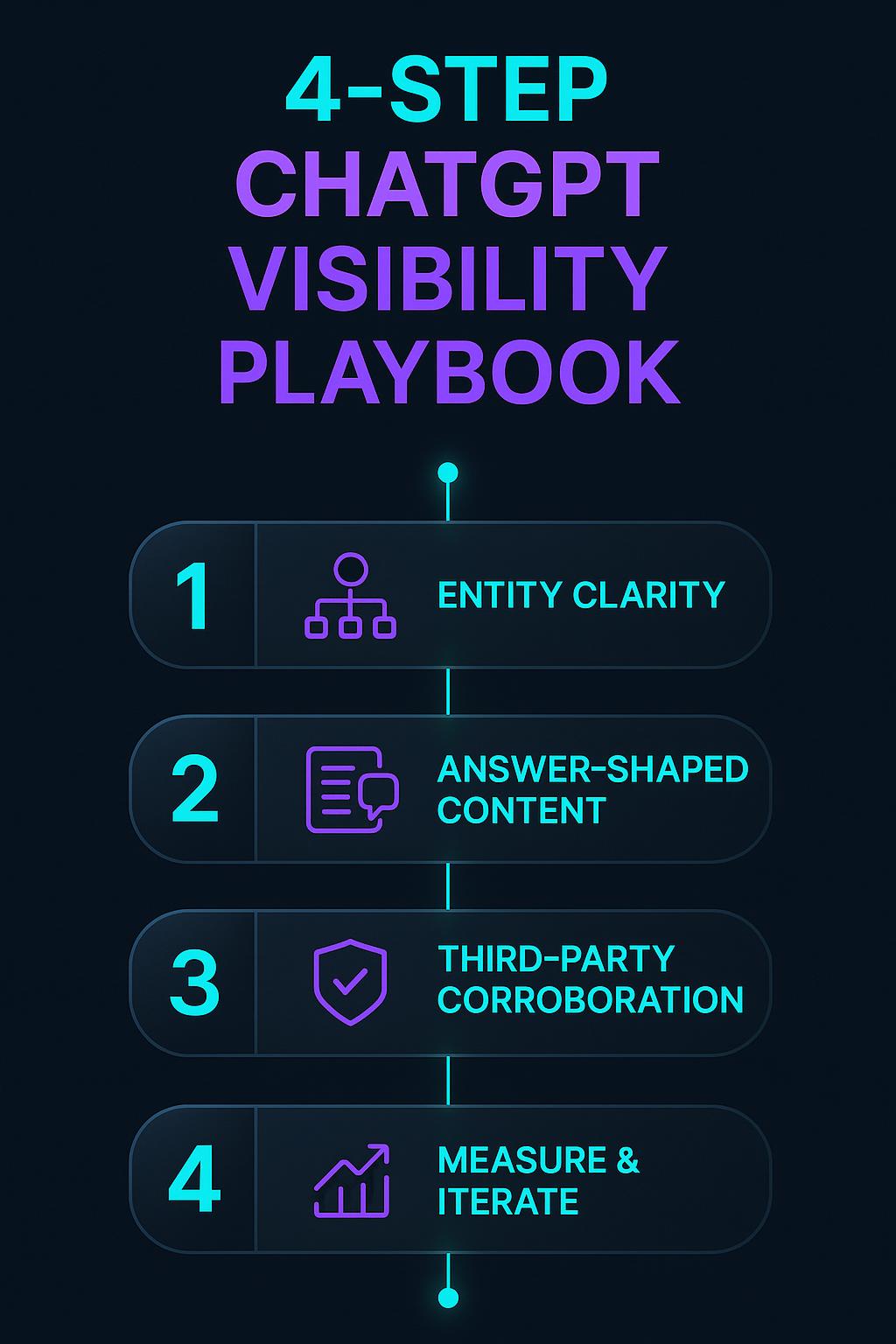
A Four-Step GEO Playbook to Increase ChatGPT Visibility
Step 1: Establish Entity Clarity
Before you optimise content or pursue coverage, confirm that your brand is unambiguously defined across the web.
Audit how your brand is described on your own properties, on third-party review platforms, on professional directories, and in any knowledge graph entries. Check for inconsistencies in how your category, your audience, your differentiation, and your name are described. The goal is that any system reading across these sources would arrive at the same coherent picture of what your brand is.
Practical actions: standardise your brand description across all owned channels; ensure your Google Business Profile and any relevant knowledge graph entries are complete and accurate; add or refine Organization schema markup on your domain to make entity attributes machine-readable; confirm that your brand name resolves to a consistent entity across major platforms.
This step is unglamorous and often underestimated. It is also the most leverage-generating action available to brands that are currently under-represented in AI answers, because entity confusion depresses citation rates across every engine.
Step 2: Publish Answer-Shaped Authoritative Content
Create content that is both genuinely authoritative and structurally accessible to synthesis systems.
Authoritative means it reflects real expertise, is factually accurate, cites evidence where relevant, and demonstrates depth. Synthesis systems weight source credibility, and thin or inaccurate content does not improve your position — in some cases it may actively harm it by introducing noise into the entity signal around your brand.
Answer-shaped means it directly addresses questions your target audience asks. Structure content around clear questions, lead with direct answers, use headers that reflect the query itself, and keep definitional content concise. Long-form depth is valuable but should be built on top of a clear, extractable core — not buried inside it.
For category-defining queries — "what is [category]", "how does [process] work", "which [type of tool] should I use" — develop dedicated content pages that take an authoritative, educational stance. These are the queries where AI answers are most commonly triggered, and they are the highest-value visibility targets.
Step 3: Earn Third-Party Corroboration
Self-published content alone does not build the corroborated signal that drives AI citation rates. You need independent sources describing your brand in consistent, positive terms.
Pursue editorial coverage in reputable publications relevant to your category. Encourage satisfied customers to leave detailed reviews on established platforms. Build relationships with analysts, researchers, or industry commentators who may reference your brand in their own published work. Contribute guest content or expert commentary to third-party publications where you can be cited by name and brand.
The goal is not volume of mentions — it is diversity of independent, credible sources all pointing to the same coherent entity. A brand mentioned briefly in twenty credible, independent sources is more visible to a language model than a brand with a thousand self-published pages and minimal third-party presence.
Step 4: Measure and Iterate
ChatGPT visibility is not a static outcome. It changes as the model is updated, as the web crawl index refreshes, as your competitors publish new content, and as query patterns in your category evolve. Optimisation without measurement is directionally blind.
Establish a baseline by monitoring how your brand appears across relevant prompt categories. Track citation frequency, citation sentiment, and which queries surface your brand versus which do not. Identify gaps — queries where you would expect to appear but do not — and use those gaps to guide content development and corroboration activity.
Measure across multiple AI engines, not just ChatGPT. Perplexity, Gemini, Claude, Grok, and DeepSeek each have different retrieval and synthesis characteristics, and your visibility profile will vary across them. A brand that performs well on one engine and poorly on another has useful signal about where its authority and entity signals are landing — and where they are not.
Monitoring ChatGPT Visibility Continuously with ApexGEO
A monitoring programme for AI visibility requires tooling built specifically for the purpose. Traditional SEO platforms measure ranking position on search result pages — a concept that does not translate to AI-generated responses. The unit of measurement is different, the feedback loop is different, and the signals that indicate progress are different.
ApexGEO MONITOR tracks brand mentions across ChatGPT, Claude, Gemini, Perplexity, Grok, DeepSeek, and Microsoft Copilot. It queries each engine with a set of topically relevant prompts and records whether and how your brand appears in each response. Over time, this builds a structured record of how your visibility evolves — across engines, across query types, and against competitive benchmarks.
The Smart Recommendations Engine within ApexGEO prioritises the specific technical and content fixes most likely to improve your visibility scores, ranked by expected impact. Rather than a generic checklist, you receive a prioritised action list drawn from your actual audit results.
ApexGEO AUDIT assesses the technical readiness of your web presence for AI discovery — schema completeness, entity markup, structured data validity, content structure — and surfaces the specific gaps that are limiting your citation potential.
ApexGEO CREATE supports the production of brand-voice content structured for AI readability, so that the content you publish is built from the ground up to be answer-forward and synthesis-compatible.
Together, these surfaces provide the measurement and iteration infrastructure that makes a GEO programme sustainable. Without measurement, optimisation becomes guesswork. Without iteration, an initial improvement is not compounded over time.
Starting Point: Know Where You Stand Today
Before you execute a playbook, you need a baseline. Most brands that begin a GEO programme are surprised by the gap between where they expect to appear in AI answers and where they actually appear. The query-level variation is often significant: strong presence on some prompts, complete absence on others that seem equally relevant.
Understanding that baseline is the first step. It tells you which of the four playbook steps is highest-leverage for your specific situation — whether the gap is primarily an entity clarity problem, a content structure problem, a corroboration problem, or a measurement gap.
Get your free AI visibility snapshot to see how your brand is currently appearing across AI answer engines, where the largest gaps are, and what the highest-impact next actions look like.
Q: Does being visible in ChatGPT require a different strategy from Google SEO?
A: It requires an extension of your SEO strategy rather than a replacement. The foundations — authoritative content, clean technical health, quality inbound links — support performance in both channels. The GEO-specific additions are entity clarity work (making your brand unambiguously legible to language models), answer-shaped content structure, and third-party corroboration from diverse independent sources. Brands with strong SEO programmes typically have a head start, but they still need to address the gaps that traditional SEO work does not cover.
Q: How long does it take to improve visibility in ChatGPT?
A: The honest answer is that it depends on which surface you are targeting. Live browsing citations can respond to content and technical improvements within weeks, assuming a crawl cycle picks up the changes. Model knowledge — the trained understanding of your brand baked into the model's weights — updates only when the model is retrained or updated, which happens on timescales outside your control. The practical implication is that you should focus on the browsing surface for shorter-term impact while building the authoritative, corroborated presence that will improve model-level representation over time.
Q: Can a small or newer brand appear in ChatGPT answers?
A: Yes, but the path is through entity clarity and corroboration rather than domain age alone. A newer brand that is clearly defined, accurately described across multiple independent sources, and publishing well-structured authoritative content in a specific niche can achieve meaningful AI visibility even without years of search history behind it. The challenge for smaller brands is typically the corroboration gap — limited third-party coverage — rather than a fundamental barrier related to brand size.
Q: Does ChatGPT use the same sources as Google?
A: Not exactly. ChatGPT's browsing layer fetches live web content, and there is overlap with sources that rank well in traditional search — because the underlying credibility signals are similar. But the selection and synthesis process is different from returning a ranked list of links. ChatGPT is constructing an answer and selecting content that contributes to that answer, which means answer-shaped, synthesis-ready content has an advantage that is distinct from pure ranking position.
Q: How do I know if ChatGPT is mentioning my brand at all?
A: Manual testing — querying ChatGPT with relevant prompts and noting whether your brand appears — provides an initial signal, but it is not scalable and does not account for query variation, engine differences, or changes over time. Purpose-built monitoring platforms like ApexGEO MONITOR query multiple AI engines systematically, across a range of relevant prompts, and track how your brand's appearance changes over time. That structured record is what turns a one-off check into an actionable visibility programme.
Q: What is the relationship between schema markup and ChatGPT visibility?
A: Schema.org markup helps search engines and AI systems understand the structured attributes of your content and your brand entity — what type of thing you are, what you do, who you serve, and how you relate to other entities. For AI visibility specifically, Organization, Product, Article, and FAQPage schema types are the most directly relevant. Well-implemented schema does not guarantee citation, but it reduces the ambiguity that causes language models to misrepresent or omit a brand. Think of it as making your entity attributes machine-readable rather than relying on a model to infer them from prose.
Q: Should I be optimising for ChatGPT specifically or for AI engines in general?
A: Both, in the right order. The foundational work — entity clarity, authoritative content, third-party corroboration, answer-shaped structure — benefits your visibility across all AI answer engines, not just ChatGPT. Engine-specific variation does exist: different platforms weight their retrieval and synthesis signals differently, update on different schedules, and surface citations in different formats. The practical approach is to build the foundational programme that lifts performance broadly, then use per-engine monitoring to identify where platform-specific gaps remain. Platforms like ApexGEO MONITOR track visibility across ChatGPT, Claude, Gemini, Perplexity, Grok, DeepSeek, and Copilot precisely because a single-engine view misses the variation that matters for a complete picture.