How Agencies Monitor AI Search Visibility: A Practical GEO Playbook
Learn how agencies monitor AI search visibility with prompt testing, citation analysis, competitor tracking, and GEO reporting workflows.
Agencies monitor AI search visibility by repeatedly testing the questions their buyers ask, recording whether the brand is mentioned, whether it is cited, which competitors appear instead, and what evidence the AI system uses to justify its answer. The work looks like SEO reporting, but the unit of measurement is different: instead of only tracking rankings for a keyword, the agency tracks answer presence, citation quality, sentiment, share of voice, and content gaps across answer engines such as ChatGPT, Claude, Gemini, Perplexity, Grok, DeepSeek, Copilot, and Google AI experiences.
The simple version is this: build a query set, run it on a schedule, capture the full AI response, score the brand against competitors, inspect which sources were cited or paraphrased, then create or improve pages that answer the missing questions with clear evidence. Repeat the same prompts over time so visibility gains are measurable rather than anecdotal.
That process is now becoming a core agency operating rhythm because AI answers are not just another search result page. They can compress a buyer's research journey into one generated recommendation. A brand can have strong traditional rankings and still be absent from a conversational answer if the model finds clearer, fresher, more specific, or better-structured evidence elsewhere. For agencies, the job is to make that absence visible, explain why it is happening, and turn it into an action plan.
This guide explains the monitoring workflow agencies use, the metrics that matter, the tooling categories involved, and how to turn an AI-search visibility report into content and technical improvements clients can understand.
What "AI search visibility" means
AI search visibility is the extent to which a brand, product, service, expert, or page appears in AI-generated answers for commercially important questions. It includes direct mentions, citations, summaries, recommendations, comparison tables, source links, and the way the AI system describes the brand relative to alternatives.
In practical agency reporting, visibility usually has six layers:
- Mention visibility: Is the brand named in the answer at all?
- Citation visibility: Is the brand's website, report, product page, or third-party profile linked or cited?
- Recommendation visibility: Is the brand merely listed, or is it recommended as a good option?
- Position visibility: Does the brand appear first, in the middle, last, or only after competitors?
- Sentiment and accuracy: Is the description positive, neutral, negative, outdated, or wrong?
- Evidence visibility: What sources, facts, and entities does the answer appear to rely on?
That distinction matters. A brand mention without a citation may still create awareness, but a cited page is easier to audit and improve. A recommendation with inaccurate facts may drive poor-fit leads. A competitor mention without your brand is a content-gap signal. Strong AI visibility means the brand is present, accurately described, supported by evidence, and associated with the buyer questions that matter.
The agency monitoring workflow in one answer
A repeatable agency workflow for AI search visibility has seven steps:
- Define the buyer questions. Start with the prompts prospects actually ask: "best provider for…", "how do I choose…", "compare…", "what is the safest way to…", and "who helps with…".
- Group prompts by intent. Separate educational, comparison, vendor-selection, local, pricing, risk, implementation, and troubleshooting prompts.
- Run the same prompts across answer engines. Test ChatGPT, Gemini, Perplexity, Claude, Grok, DeepSeek, Copilot, and relevant search AI surfaces where possible.
- Capture the raw answers. Store full responses, citations, timestamps, model/platform names, region, and device or account conditions where relevant.
- Score the brand and competitors. Track mention rate, citation rate, share of voice, position, sentiment, accuracy, and competitor displacement.
- Diagnose the content gap. Identify which missing pages, weak explanations, stale facts, poor schema, thin FAQs, or weak third-party references are causing invisibility.
- Publish and retest. Improve the content, technical structure, and authority signals, then rerun the same prompt set to measure whether the answer changed.
Agencies that do this well treat AI visibility monitoring as a controlled measurement system. They do not rely on one manual ChatGPT test. They build prompt libraries, test on a cadence, preserve evidence, and separate one-off model variation from persistent visibility patterns.
Step 1: Build a prompt set that reflects real buying journeys
The most useful AI visibility dashboards start with the right questions. Agencies should not monitor only short SEO keywords. AI answers are often triggered by full, natural-language prompts such as:
- "How do agencies monitor AI search visibility?"
- "Which companies help African brands appear in ChatGPT answers?"
- "What should I check before choosing a GEO platform?"
- "Best answer engine optimisation tools for B2B agencies"
- "How do I measure whether my brand appears in Perplexity or Gemini?"
A good prompt set covers every stage of the buyer journey:
Informational prompts
These ask for education, definitions, and frameworks. They reveal whether the brand is associated with the category itself. Example: "What is answer engine optimisation?"
Comparison prompts
These ask the model to compare options, tools, vendors, or approaches. They are high value because they expose competitor displacement. Example: "Compare GEO monitoring tools for agencies."
Recommendation prompts
These are close to purchase intent. Example: "Who can help my company monitor AI search visibility?"
Local and regional prompts
For African markets, prompts should include region-specific language, country names, city names, and market realities. An agency serving South Africa, Kenya, Nigeria, Ghana, or pan-African B2B clients should not rely only on US-centric prompts.
Problem and risk prompts
These surface credibility issues. Example: "Why is my brand not showing up in AI answers?" or "Can AI search visibility reports be misleading?"
The prompt library should be versioned. If prompts change every week, trend data becomes noisy. Agencies can add new prompts, but the core benchmark set should remain stable enough to compare results over time.
Step 2: Test across multiple AI answer engines
No single AI platform represents the whole market. Agencies monitor several engines because each system can retrieve, summarise, and cite information differently. A brand might appear in Perplexity because a strong article is cited, but be absent in ChatGPT for the same prompt. Another brand might appear in Gemini because of broader web associations, but not in a citation-heavy answer engine.
A practical monitoring stack should include the platforms most relevant to the client's market and sales process. For many B2B teams, that means testing a mix of conversational AI systems, citation-led answer engines, and AI-enhanced search experiences. ApexGEO's own platform configuration, for example, tracks major engines such as ChatGPT, Claude, Gemini, Perplexity, Grok, DeepSeek, and Microsoft Copilot in its monitoring layer, with browser variants separated where automation conditions differ.
When agencies run tests, they should record the context around each response:
- Platform or model name
- Prompt text
- Date and time
- Region or language setting when available
- Whether the query was run through an API, browser session, or search interface
- Full answer text
- Cited URLs, if the platform provides them
- Brand mentions and competitor mentions
- Observed sentiment and factual errors
This evidence trail matters when reporting to clients. A screenshot or raw response log is more convincing than a slide that says visibility is "up" or "down" without proof.
Step 3: Measure mention rate, not just rankings
Traditional SEO reports often focus on rank position, impressions, clicks, and organic sessions. AI visibility reports need different metrics because many answers do not behave like a list of ten blue links.
The core metric is mention rate: the percentage of monitored prompt runs in which the brand is named. If a brand appears in 12 out of 40 prompt-platform runs, its mention rate for that benchmark is 30%. Agencies usually segment that by platform, prompt cluster, market, and intent.
Mention rate is useful, but it is not enough. Agencies should also track:
Citation rate
How often does the AI answer cite the brand's website or a trusted page about the brand? Citation rate helps separate vague model memory from retrievable evidence.
Share of voice
Which competitors are named more often? A brand may have a 30% mention rate, but if two competitors appear in 80% of comparison prompts, the client is still losing the category narrative.
Position and prominence
Is the brand first in a recommendation list, buried in a long paragraph, or mentioned only as an afterthought? Prominence often matters more than raw presence.
Sentiment and framing
Does the answer describe the brand as established, niche, expensive, local, innovative, risky, or outdated? Agencies should flag harmful or inaccurate framing separately from visibility.
Answer accuracy
AI answers can contain outdated product names, wrong service areas, incorrect pricing assumptions, or invented limitations. Accuracy monitoring protects brand trust.
Source diversity
Which pages and domains are repeatedly cited? If only one third-party directory supports the brand's visibility, that creates fragility. Strong visibility is usually supported by multiple clear, consistent sources.
Step 4: Capture citations and source evidence
Citation analysis is where AI visibility monitoring becomes actionable. The key question is not only "did the model mention us?" but "what evidence did it have available?"
Agencies should classify cited sources into categories:
- Client-owned pages, such as service pages, product pages, blog articles, case studies, and documentation
- Third-party profiles, such as directories, review sites, partner pages, podcasts, interviews, and news mentions
- Competitor-owned pages
- Neutral educational resources
- Outdated or low-quality sources
Then they should inspect what the cited sources do better than the client's content. In many cases, the winning source is not longer; it is clearer. It may define the category in the first paragraph, answer the exact buyer question, include a concise comparison, use structured headings, or contain an FAQ that an answer engine can extract cleanly.
For agencies, citation monitoring should produce a content backlog. If a competitor is cited for "how to choose a GEO platform," the agency should ask:
- Does the client have a page that answers that exact question?
- Is the page written for a human decision-maker, not just for keywords?
- Does it include specific criteria, examples, limitations, and definitions?
- Is the content crawlable and internally linked?
- Does it include structured data where appropriate?
- Is the page fresh enough to reflect the current product and market?
The output of citation analysis should be a prioritised list of pages to create, update, consolidate, or support with external authority.
Step 5: Diagnose why competitors appear instead
When a competitor appears in an AI answer and the client does not, agencies should resist the temptation to treat it as a mysterious model preference. In most cases, there are practical signals to inspect.
Common reasons competitors win AI answers include:
They answer the exact question more directly
A service page that says "we help with digital growth" is weaker than a page that says "we monitor whether your brand appears in ChatGPT, Gemini, Perplexity, Claude, Grok, and DeepSeek answers for your buyer questions." Specificity gives the model usable language.
They have clearer entities
AI systems need to understand who the company is, what it does, who it serves, and how it differs. Inconsistent naming, vague positioning, and thin about pages make entity understanding harder.
They have better extraction structure
H2s, H3s, short definitions, comparison tables, FAQs, and concise summaries make it easier for answer systems to reuse content accurately. Dense marketing copy is harder to cite.
They are supported by third-party corroboration
A brand described consistently across partner pages, interviews, directories, reviews, and industry articles gives AI systems more corroborating evidence than a brand that exists only on its own homepage.
They publish fresher content
AI search categories change quickly. Content about generative AI, answer engines, and AI search visibility can become stale if it does not reflect current platforms and buyer questions.
Their technical foundation is cleaner
Crawlability, page speed, canonical tags, internal links, structured data, and indexable content still matter. AI visibility does not replace technical SEO; it adds another layer to it.
A good agency report should connect visibility losses to these causes rather than simply showing screenshots of competitor mentions.
Step 6: Turn monitoring into a weekly operating cadence
AI search visibility monitoring works best when it becomes a cadence, not a quarterly surprise. A practical agency rhythm looks like this:
Weekly
Run the core prompt set, check for major visibility changes, review new competitor mentions, and flag urgent accuracy issues.
Monthly
Group results by platform and intent, update the content backlog, review citation patterns, and present client-facing insights.
Quarterly
Refresh the prompt library, reassess competitor sets, update regional prompts, review technical foundations, and compare AI visibility against business outcomes such as qualified leads or demo requests.
This cadence helps agencies avoid overreacting to one volatile answer. The goal is to identify persistent patterns: repeated absence from buying prompts, repeated competitor recommendations, repeated citation of a particular page, or repeated misdescription of the brand.
Step 7: Create content that answer engines can quote
The strongest response to an AI visibility gap is not generic blog volume. It is precise, evidence-led content designed to answer the missing question better than anything else available.
For a query such as "How do agencies monitor AI search visibility?", an answer-worthy page should include:
- A direct answer in the opening section
- A step-by-step monitoring workflow
- Definitions of key metrics such as mention rate, citation rate, share of voice, sentiment, and answer accuracy
- Examples of prompt categories
- A practical reporting cadence
- Clear caveats about volatility and evidence quality
- FAQs that match follow-up questions buyers ask
The content should also avoid unsupported claims. If the agency does not have a verified number, it should not invent one. If a model output is anecdotal, it should be labelled as a prompt-run result, not market truth. This discipline is especially important in AI-search reporting because clients are buying trust. A fabricated benchmark can damage the whole program.
ApexGEO's positioning is built around that discipline: monitor real prompt runs, identify where a brand is absent, and generate content that addresses the precise gap rather than producing generic SEO filler. For African brands and agencies, that matters because global AI answers can easily over-index on US or European sources unless regional expertise is made explicit, crawlable, and easy to cite.
What an AI visibility report should include
A useful agency report should be short enough for executives and detailed enough for operators. Include these sections:
- Executive summary: What changed, why it matters, and the recommended next action.
- Prompt coverage: Which questions, platforms, regions, and intent categories were tested.
- Visibility metrics: Mention rate, citation rate, share of voice, prominence, sentiment, and accuracy.
- Competitor displacement: Which competitors appeared instead and in which prompt clusters.
- Citation analysis: Which pages were cited, which were missing, and what content formats worked.
- Accuracy issues: Any wrong or outdated statements about the brand.
- Recommended actions: Content updates, new pages, technical fixes, schema improvements, digital PR, or third-party profile updates.
- Retest plan: When the same prompts will be rerun and what success will look like.
The report should preserve raw evidence. Clients should be able to inspect the underlying responses, not just the agency's interpretation.
The bottom line
Agencies monitor AI search visibility by building a controlled prompt set, testing it across multiple answer engines, capturing the raw responses, scoring brand and competitor presence, analysing citations, and turning the gaps into specific content and technical work. The best agencies make this process repeatable. They can show which questions the brand wins, where it is absent, which competitors are shaping the answer, and what evidence is needed to change the result.
For brands, the strategic question is no longer only "Do we rank?" It is also "Are we part of the answer when buyers ask AI for advice?" Monitoring gives agencies the evidence to answer that question honestly and improve it over time.
Take the Next Step
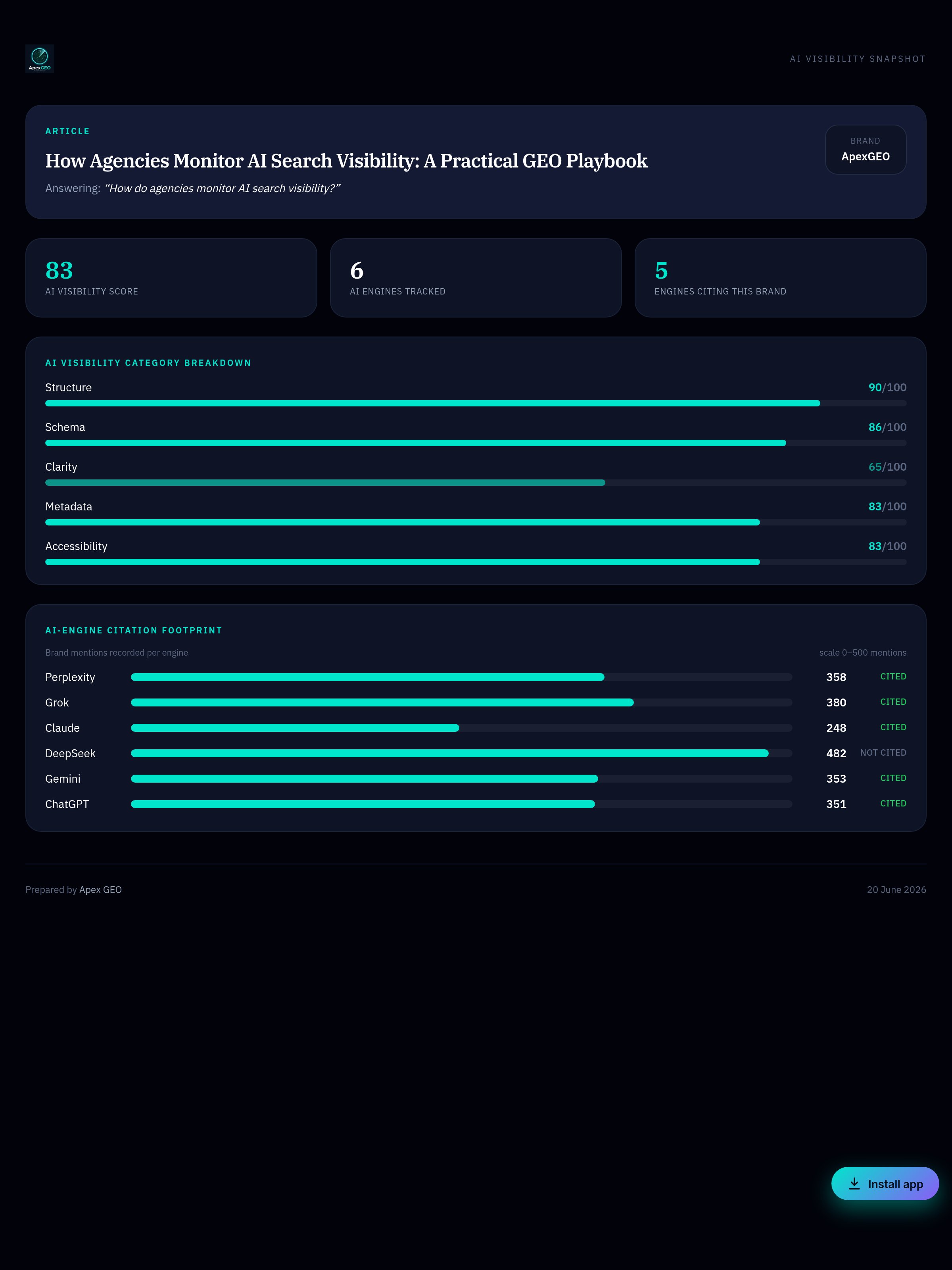
If you want to see where your brand currently stands across AI answer engines, ApexGEO offers a free AI visibility snapshot that shows where you are cited, where you are absent, and where the largest opportunities lie. Get your free AI visibility snapshot and start measuring what traditional rank trackers cannot show.
Q: How do agencies monitor AI search visibility?
A: Agencies monitor AI search visibility by running a defined set of buyer questions across AI answer engines, capturing the responses, and scoring whether the brand is mentioned, cited, recommended, accurately described, and positioned against competitors. They repeat the same prompts over time to separate persistent patterns from one-off model variation.
Q: What metrics matter most in AI visibility reporting?
A: The most useful metrics are mention rate, citation rate, share of voice versus competitors, answer prominence, sentiment, factual accuracy, and source quality. Traditional SEO metrics still matter, but AI visibility reporting must also show how the brand appears inside generated answers.
Q: How often should an agency test AI search visibility?
A: For active campaigns, a weekly monitoring cadence is practical for detecting visibility changes and accuracy issues, with deeper monthly analysis for content planning and client reporting. The key is to keep a stable benchmark prompt set so changes can be compared over time.
Q: Why does a competitor appear in AI answers when my brand does not?
A: Competitors often appear because they answer the exact question more directly, have clearer entity signals, are supported by third-party sources, provide fresher content, or structure their pages in a way that answer engines can extract. Monitoring should identify which of those causes is most likely.
Q: Can AI search visibility be improved with content alone?
A: Content is usually central, but it is not the only lever. Agencies should also review crawlability, internal linking, structured data, third-party corroboration, brand consistency, technical SEO, and whether the content is specific enough to answer real buyer questions.